
More
    Home Blog Page 14

    Cycle & Carriage: From Bicycles to Luxury Mercs

    0

    The Humble Beginnings

    Back in 1899, the story starts with a small-time shop in Kuala Lumpur. Picture this: two brothers (the Federal Stores founders) trading sundry goods—nutmeg, writing paper, soap—you name it. Then bicycles entered the scene. And everything changed. Suddenly the shop wasn’t just about soap—it was about wheels. Literally. They renamed themselves Cycle & Carriage and shifted from carrying nutmegs to selling bicycles, then motor vehicles.

    Federal Stores (which was later renamed Cycle & Carriage). Source
    YearEvent
    1899Founded as “Federal Stores” in Kuala Lumpur. Began as a merchant trading nutmegs and sundry goods.
    1899 (June)Renamed to Cycle & Carriage. Transitioned into selling bicycles, carriages, then motor vehicles.
    1904Moved to corner of High Street/Market Square. Expansion toward major city locations (Kuala Lumpur region).
    1951Awarded the franchise for Mercedes‑Benz in Singapore. First in Southeast Asia for that brand.
    1965Built assembly plant in Hillview, Singapore. A key step in local manufacturing and industry participation.
    1969IPO on Stock Exchange of Malaysia & Singapore. Offer hugely oversubscribed (approx 73 ×).
    2002Became subsidiary of Jardine Matheson Group. Major restructuring, new ownership.
    2004Officially renamed to Jardine Cycle & Carriage Ltd. Reflecting integration into Jardine group.
    2019Celebrated 120-year anniversary. Marking long‐term survival through many economic cycles.
    Cycle & Carriage registered as a private limited liability company. Source

    World War, Disruption & Resilience

    Of course, life doesn’t go smoothly. WWII came along, and the company’s operations were heavily disrupted. But here’s the thing—they bounced back. Post-war growth kicked in, and by 1951, they snagged the franchise for Mercedes‑Benz in Singapore—the first in Southeast Asia. Big move. And if you’re thinking, “Cool, but that’s just a car company”—we’re only getting started.

    Cycle & Carriage was the first enterprise to represent the Mercedes-Benz brand in Southeast Asia. Source

    Expansion, Listing & Empire-Building

    Fast forward to the 1960s: they set up an assembly plant in Singapore (Hillview) to boost local manufacturing and employment. In 1969, the company went public as Cycle & Carriage Ltd in Malaysia and Singapore. The IPO? Let’s just say the demand was off the charts—oversubscribed 73 times. That’s not just “popular”—that’s “everybody wants a slice.”

    They didn’t stick just to selling cars. By the late 80s and early 90s they ventured into property development and food retail (hello, supermarkets and villas). Diversification became their thing.

     Cycle & Carriage’s first residential property development. Source

    The Big Join-Up & Modern Era

    Then comes 2002: Jardine Matheson Group takes majority control of Cycle & Carriage. By 2004 the rebrand happens and voila: Jardine Cycle & Carriage (JCC) is born.

    239 Alexandra Road – Cycle Carriage Headquaters

    Today, JCC is massive. It’s not just about selling Mercs. It holds stakes in heavy equipment, agribusiness, property, logistics across Southeast Asia (Indonesia, Vietnam, Myanmar, Singapore). Their automotive distribution and retail remains a core, but the empire is diversified.


    Key Business Highlights to Remember

    • Automotive distribution & retail (brands include Mercedes-Benz, Mitsubishi, Kia, Citroën) in Singapore/Malaysia/Myanmar.
    • Investment holding in regional companies (e.g., PT Astra International Tbk in Indonesia).
    • Expanded beyond cars: heavy equipment, agribusiness, property development, logistics.

    My Point of View (Yes—I have one)

    Okay, omgsogd.com reader—here’s me being frank: The story of JCC is inspiring, but also a bit of a cautionary tale. Why? Because it shows how something small (bicycles and sundries) can turn big. But big doesn’t mean immune to disruption. As the world shifts toward electric vehicles (EVs), sustainability, and digital mobility, the “car dealer empire” model might face rough patches.

    If I were advising JCC (or anyone like them), I’d say: double down on EVs, mobility-services (car-sharing, battery-swap), and tech partnerships—and not just “we’ll do it later.” Because the next wave is coming—fast. The company’s history shows resilience and adaptability, so I genuinely think they’re in a decent spot. But complacency? That’s the real risk.

    Also—and this is just me chatting—there’s something poetic about their journey: from selling bikes (humble beginnings) to slinging luxury rides across Asia. It’s a symbol of regional growth, of changing economies, and of how even big brands had to pivot multiple times to stay relevant.


    Why This Story Matters for You and Me

    • For investors: This company isn’t just a “car-sales outfit.” It’s a diversified holding with roots in Southeast Asia’s growth story.
    • For business watchers: It’s a textbook of expansion, re-branding, strategic alliances, and diversification.
    • For everyday folks: It’s proof that small starts can lead to big empires—and that adaptability is key.

    Final Thoughts

    So there you have it—an old shop selling nutmeg and bicycles in 1899 turned into a major player in Southeast Asia’s automotive and investment scene. The lesson? Stay nimble, keep evolving, and don’t underestimate the small beginnings. Because you never know when you’ll be selling luxury rides instead of nutmeg. 😉

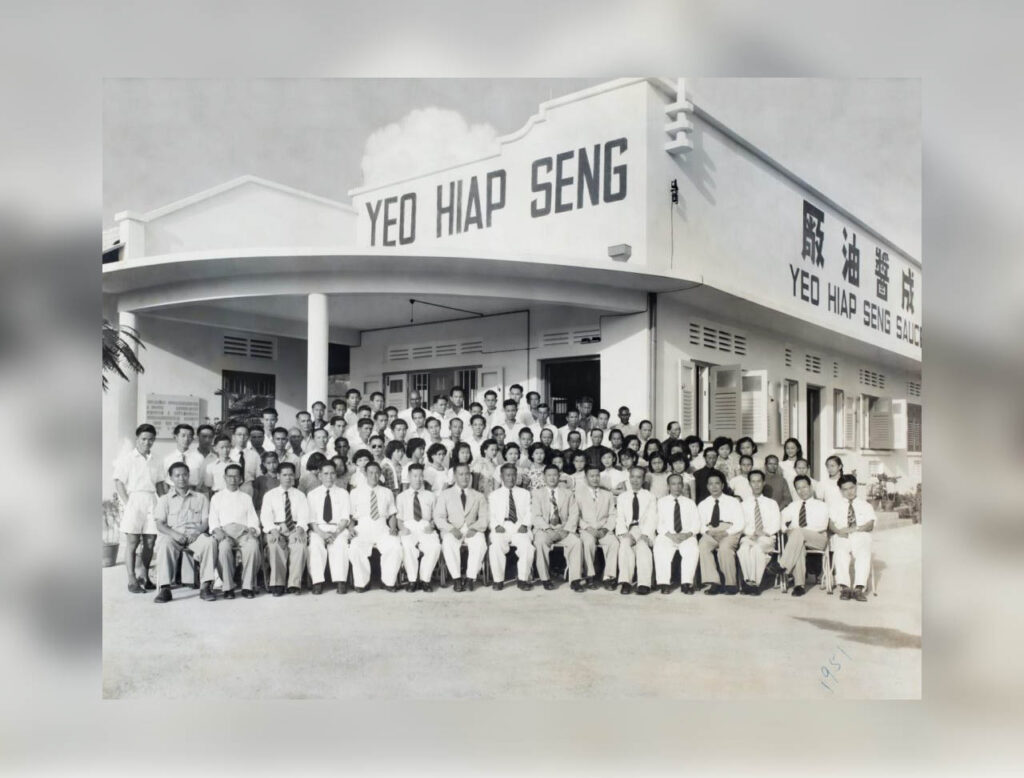
    How the Yeo Family Lost Yeo’s

    0
    Source: Heritance

    Yeo Hiap Seng started small: a soy-sauce stall in Fujian in 1900, turned into a Singapore factory by the 1930s. From bottles to canned food to ready-to-drink tea, the company grew into a household name across Asia. Yet, despite decades of wins and clever product moves (hello, Tetra Brik cartons), the company’s biggest threat wasn’t a rival or a lousy product. It was family.

    ItemInfo
    FoundedStarted as a soy-sauce business in 1900 by Yeo Keng Lian in Fujian, China.
    First Singapore factoryThe family set up the Yeo Hiap Seng sauce factory in Singapore in the 1930s.
    IncorporatedIncorporated in Singapore as Yeo Hiap Seng Canning & Sauce Factory on 20 Dec 1955.
    Listed on SGXBecame a public company around 1968–1969 (sources cite 7 Nov 1968 or 1969).
    Main productsMakes sauces, canned foods, and non-alcoholic beverages (Asian drinks and teas).
    MarketsSells across Asia and other regions; products available in many countries (regional and international distribution).
    Major takeoverControl passed to the Ng family (Orchard Parade / Far East) after a takeover in the mid-1990s (1995).
    Current HQ / registered officeRegistered office listed at 3 Senoko Way, Singapore 758057.
    Business todayOperates as a food & beverage company and investment holding group; it also develops property.

    The rise: humble roots, big ambitions

    In 1900, Yeo Keng Lian brewed sauces in Fujian. His sons carried the trade to Singapore in the 1930s and set up a proper sauce factory. The strategy was simple: make things locals actually wanted. That meant bottled Hokkien-style sauce, tinned food, and later, drinks aimed at Chinese tastes — a niche the big player, F&N, mostly ignored.

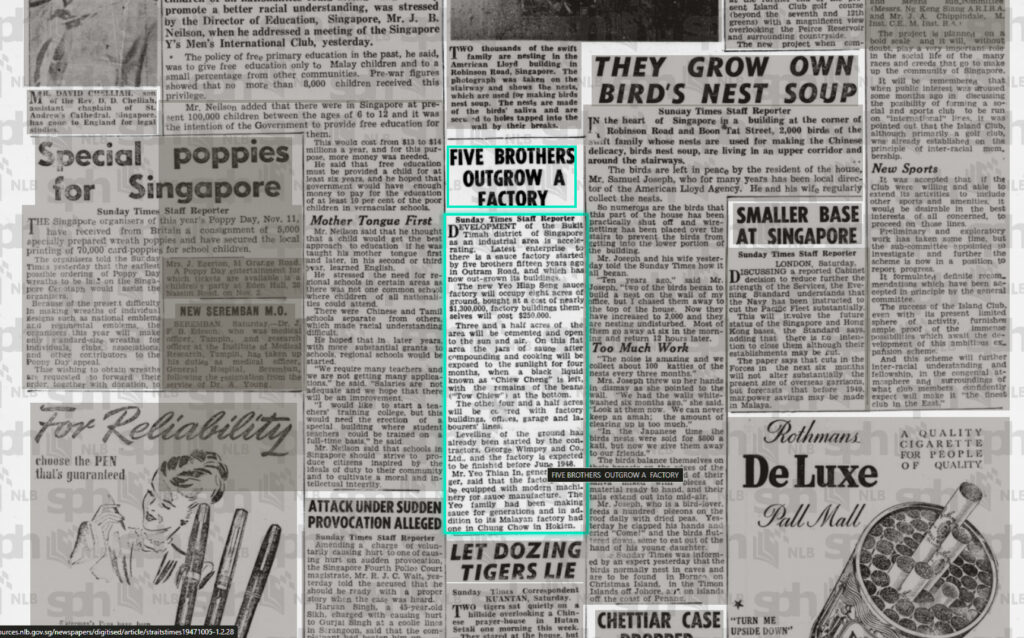
    FIVE BROTHERS OUTGROW A FACTORY
    The Straits Times, 5 October 1947, Page 3 (source)

    Fast forward: by the 1950s the company was canning curries and bottling soy milk. By the 1960s it was packing soft drinks in Tetra Brik cartons — a first for the region. Then came the listing on the Singapore Exchange in 1969. The Yeos were no longer just a family business. They were a public company with regional reach.

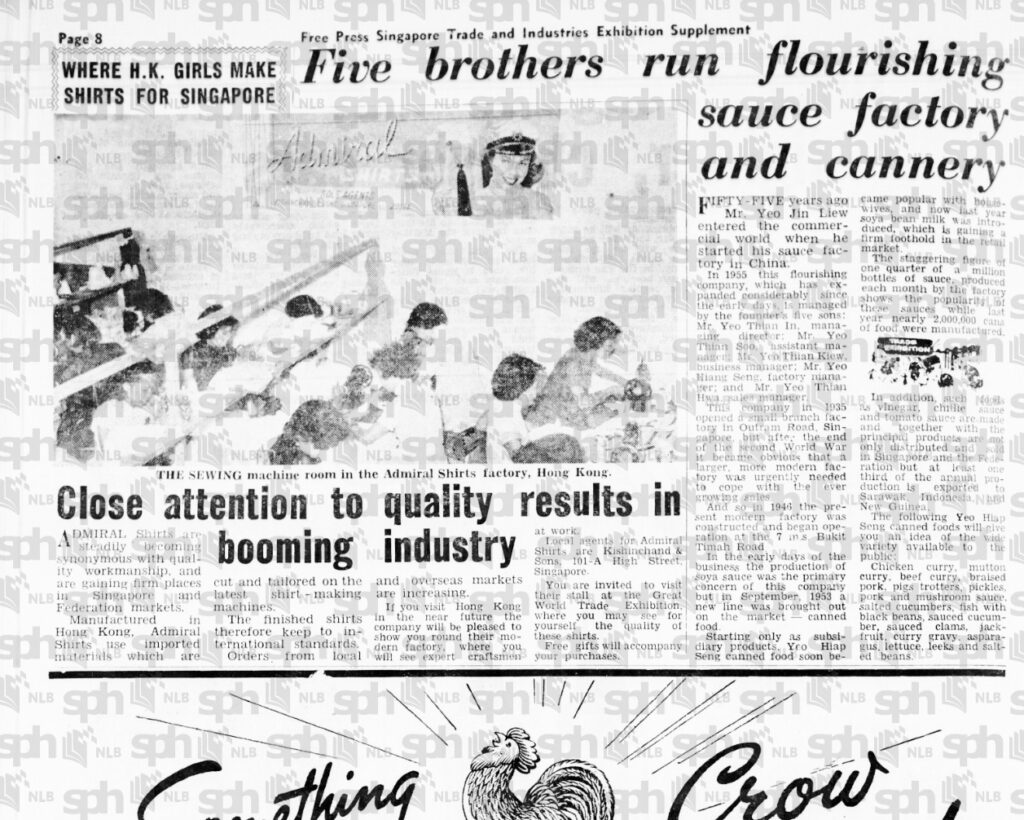
    The Singapore Free Press, 7 October 1955: Five brothers run flourishing sauce factory and cannery (source)

    So far, so good. But growth breeds complexity. New markets demand new capital. New capital often means outsiders. And outsiders trigger arguments in families who built things with elbow grease and shared memories.


    The pivot: expansion, risk, and a costly gamble

    By the 1980s, YHS was not only in food and drinks but also dabbling in property and even U.S. ventures. One big bet was the joint acquisition of Chun King in the U.S. That deal cost them. It lost money. And when money vanishes, so does patience.

    Alan Yeo, who steered the company into larger plays, pushed hard for growth. He wanted partners, deals, and faster expansion. Some family members saw this as ambition. Others saw it as risk — and a dilution of family control. Tensions crept in. Meetings became votes. Votes became legal actions.


    The family feud: when strategy turned personal


    Ng Teng Fong to launch takeover of Yeo Hiap Seng
    The Business Times, 22 March 1995, Page 1 (source)

    By the early 1990s, the clan was split. Side A supported Alan’s growth plan. Side B wanted to protect the company’s traditional identity and assets — especially land that was suddenly worth a lot more after rezoning. Instead of honest conversations and a clear succession plan, the Yeos drifted toward legal rows. Alan petitioned to dissolve the family holding company. The family block fractured. Shares scattered.


    Alan Yeo: I’ll dissolve holding company rather than sell out
    The Business Times, 6 May 1994, Page 1 (source)

    Once unity cracks, vultures circle. Not literally, but close: property heavyweights noticed YHS’s land in Bukit Timah. With the Yeos divided and their holdings fragmented, buying a controlling stake became doable. Orchard Parade Holdings — backed by Ng Teng Fong’s group — slowly accumulated shares on the open market. By 1995, after a ferocious battle for control, the Ng family emerged the winner.

    The Yeos? They walked away from direct control of the brand their ancestors built over almost a century.


    After the takeover: brand vs. empire

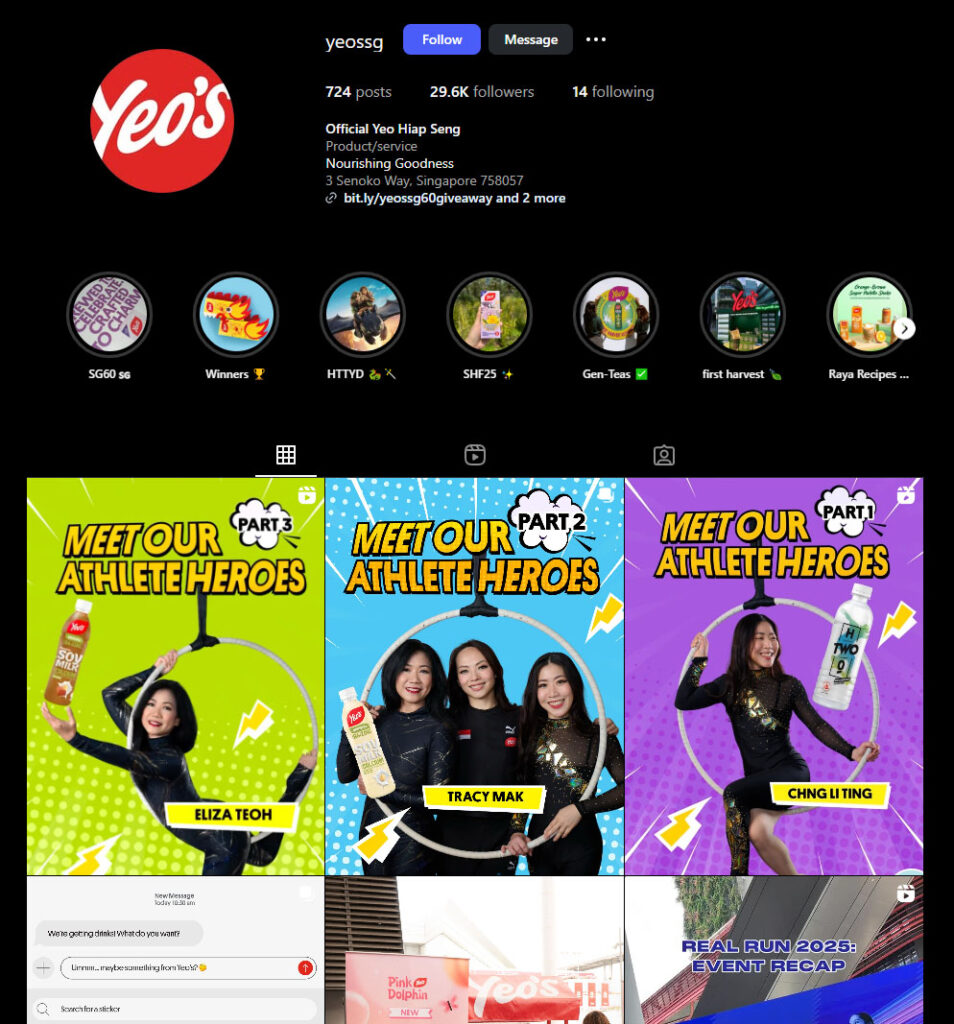
    Source: https://www.instagram.com/yeossg

    Under Ng’s control, YHS pivoted further into real estate. The factory moved. The land changed hands. The company kept selling familiar products — beverages people grew up with — but its identity had changed. That familiar nostalgia remained. Yet the empire-style growth and the profitability of earlier decades faded into memory.

    The broader lesson: brand loyalty can survive ownership changes. But family control is fragile without clear succession, governance, and communication.


    Why this mattered — and why it still does

    First, it’s a corporate lesson. Family businesses are different from regular corporations. Emotions, history, and personal pride matter. When those things aren’t handled with structure — clear voting rules, updated constitutions, or independent governance — disputes get ugly and expensive.

    Second, it’s a market lesson. Family ownership can be a strength, but in fast-moving markets, access to capital and partners matters. Families that refuse to adapt or that splinter under pressure can lose control quickly.

    Finally, it’s a human lesson: money makes people argue. But unresolved conflict, especially about direction and values, can cost a legacy more than market competition ever will.


    My take

    Look, building something for generations creates deep loyalty. It also creates fragile egos. The Yeo story is classic: a brilliant founding family, great products, then a stretch too far without bringing everyone on the same page. They didn’t just lose control — they lost momentum. That could’ve been avoided with clearer governance and a willingness to compromise sooner.

    If a family business asks me for advice (and they should), I’d say: write the rules while trust is high. Formalize roles. Agree on decision thresholds. Make room for outside expertise without treating it like betrayal. And for heaven’s sake, stop confusing family democracy for corporate governance.

    What Happened: Khor Gek Hong (1983) & Frankie Tan (1984)

    0

    Forty years later, the wounds still look fresh. Two murders. One year apart. One woman. One man. Both torn apart by affairs, jealousy and choices that spiraled into violence. This is the story of Khor Gek Hong and Tan Tik Siah — Frankie — and the messy human things that led to their deaths.

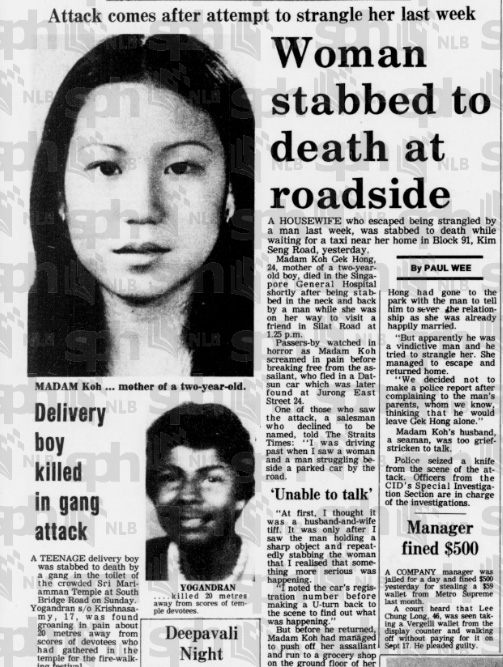
    Khor Gek Hong — a midday attack on Kim Seng Road (24 Oct 1983)

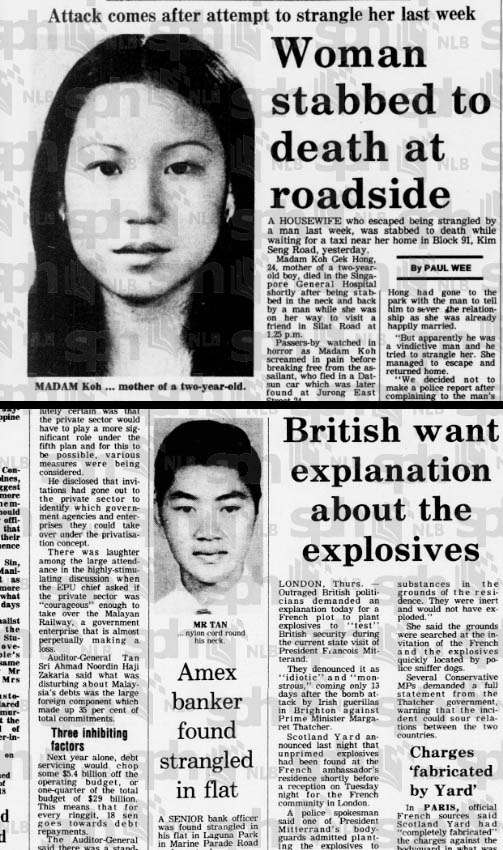
    Source: SPH

    Khor Gek Hong, 24, was the seventh of eight children. She had a husband who worked at sea and a two-year-old son. For years she had an affair with a neighbour-turned-lover, Wong Foot Ling (called Ah Beng). They knew each other since 1973. They traveled. They were intimate. Yet Khor could not decide whether to leave her husband or stay.

    CID was looking for Wong Foot Ling: Source

    Then, at noon, things turned violent. While waiting near Block 91 Kim Seng Road, she refused a lift from Wong. He pulled a knife from his car and stabbed her multiple times. One wound pierced deep into her chest — about six centimetres — and hit her lungs. In pain, she crawled to the grocery below her flat and called her mother. By the time help arrived she was in critical condition. She died that same day.

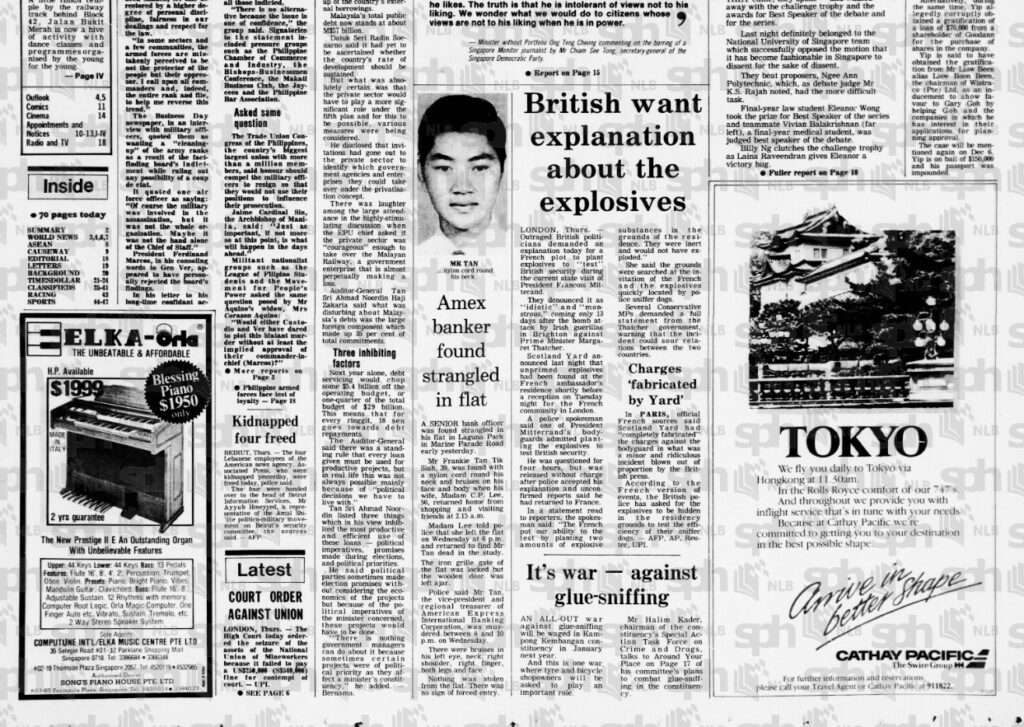
    Frankie Tan — plotted ambush in Laguna Park (24 Oct 1984)

    Amex banker found strangled in flat: Source

    A year later, on the same date, another violent ending played out. Frankie Tan, 39, a banker, was attacked in his own study. The plan was not a blind rage. It was plotted. Three men — including two Thai construction workers — ambushed him. They were recruited by Frankie’s adopted brother, Vavasan Sathiadew. Lee Chee Poh, Frankie’s wife, was involved too.

    Lee’s story is complicated and tragic. She met Frankie in the 1960s when she worked at a cabaret. She loved him. She supported him. She even raised money to help him through financial trouble. Yet Frankie had an 11-year affair, fathered a child with his mistress, and regularly abused Lee. He brought his mistress home and treated Lee like a second-class resident in her own house.

    After years of humiliation and repeated abuse, Lee snapped — or rather, she agreed to a plot hatched by Vavasan. Two days before the killing, Lee fetched Frankie from the airport. He abused her again. That was the last straw. The attack in Laguna Park turned fatal when the conspirators strangled and beat him.

    Parallels — What links the two cases?

    First, both cases grew from relationships gone toxic. Second, betrayal played a starring role. Third, both deaths were violent and final. But the ways they happened differ:

    • Khor’s death was a sudden, personal rage — a direct stabbing by a lover. It felt raw and immediate.
    • Frankie’s death was premeditated and organised. It involved conspirators, recruitment and planning.

    Still, both show how love, sex and power can mutate into something deadly when combined with jealousy, shame and a refusal to heal.

    Why these stories still matter

    Because they’re not just crime headlines. They’re cautionary tales about human costs. They show how far people can fall when relationships are allowed to rot. They show victims beyond the one who died: children left without parents, families haunted by shame, and survivors carrying the long-term scars of violence.

    Also, these cases highlight issues that remain relevant: domestic abuse, toxic masculinity, revenge culture, and how desperation can push people to conspire. These are not ancient problems. They’re still with us.

    My take — blunt, but honest

    People keep pretending heartbreak is tidy. It’s not. It’s messy. It’s loud. It’s bone-deep. In both stories, basic things were ignored: communication, accountability, and help. When one person cheats or hurts another, the ripple doesn’t stop at hearts. It goes to homes, jobs, kids, and sometimes into bloodshed.

    Here’s the kicker: neither murder solved anything. They ended hopes, stopped courts from fixing wrongs constructively, and left families in ruin. If you’re reading this and thinking, “That could never be me,” cool. But if you’ve ever stayed in a toxic relationship out of shame or fear, don’t sleepwalk into resentment. Get help. Talk to someone. Walk away if you must. Violence is never the answer.

    Small lessons tucked in the tragedy

    • Infidelity often hides deeper problems. Don’t treat affairs like discrete events. They signal damage.
    • Abuse escalates if unchecked. Early intervention matters.
    • Revenge rarely fixes pain. It multiplies it.
    • When emotions run hot, pause. Seek counsel. Legal help. Safe spaces. There are options beyond violence.

    Final thought

    Forty years on, names haven’t healed and scars haven’t faded. Khor and Frankie are reminders that love can quickly flip into something lethal when people refuse to repair what’s broken. These tales aren’t just about murder. They are about choices — and the cost of making the wrong ones.

    Remembering 4-Year-Old Megan Khung

    0

    Megan Khung Yu Wai (4) — 4 October 2015 – 22 February 2020

    Remember her name: Megan Khung. Short life. Long, brutal story. This is her story told plainly, so we don’t forget what happened and why it matters.

    First, the facts. For about a year, Megan lived under terrible cruelty. Her mother, Foo Li Ping, and her mother’s boyfriend, Wong Shi Xiang, repeatedly hurt her. They beat her. They starved her. They humiliated her. They took away the simple things a child needs: warmth, clothing, safety, school.

    Then the abuse got worse. She was shoved into small, exposed sleeping spaces. She ate from bins. Her head was shaved. She was forced into degrading acts meant to shame. Staff at her preschool noticed bruises on her face, arms and feet. Her mother withdrew her from school soon after.

    On the night of 21 February 2020, Megan was punched in the stomach. Hours later, she was dead. Her last words to her mother were, “Mummy, I am sorry.” After that, her body was hidden. It was wrapped and sealed, kept in a rented flat for nearly three months. In May 2020, her remains were burned and then scattered into the sea at East Coast Park. The truth only surfaced months after she died. Her funeral had an empty coffin filled with toys.

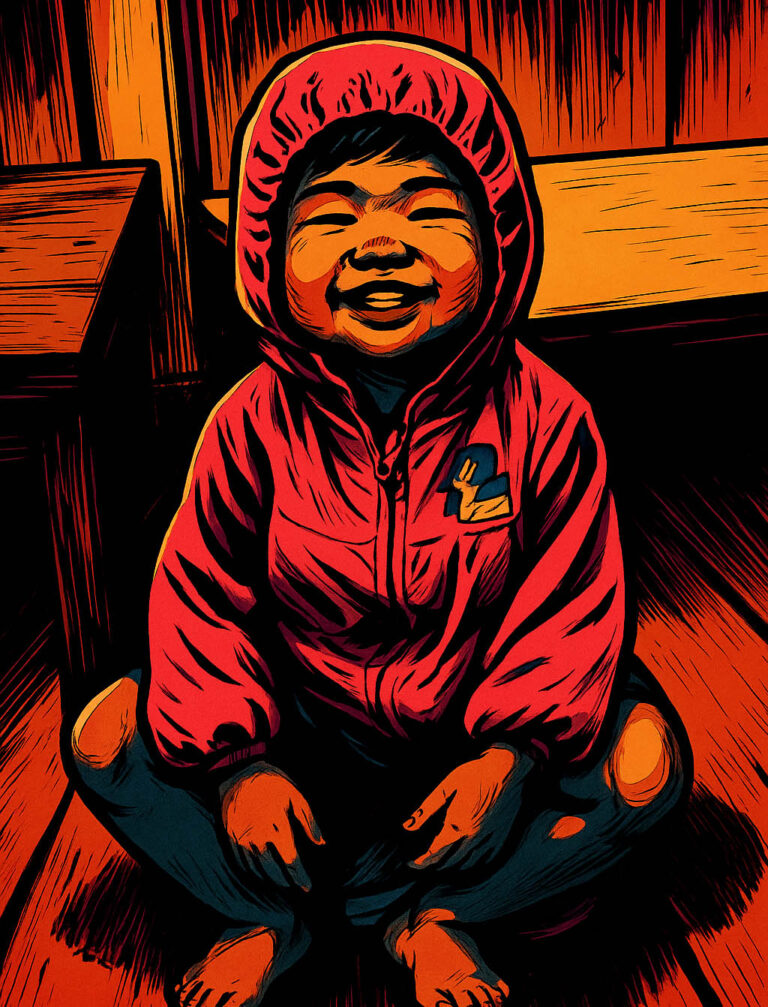
    This was not a single moment of anger. It was ongoing, systematic abuse. It left a family broken and a community stunned. Her grandparents remember a cheerful little girl. They kept photos. They called her their little sheep. Her smile was, by all accounts, radiant. Her father later turned his life around, leaving drugs behind and finding purpose in creating content and building a business — he now honors Megan in his work and actions.

    So why tell this again? Because the story forces us to answer uncomfortable questions. How did no one stop this? How could help arrive sooner? How do we protect children who cannot speak for themselves?

    What the details show

    • The injuries and humiliation were repeated. That points to negligence and cruelty, not a one-off mistake.
    • Removing a child from school after bruises appear is a red flag, not a solution. Schools and carers are part of the safety net.
    • Hiding the body and disposing of remains shows deliberate cover-up. That deepens the cruelty and the crime.
    • The ripple effects are real. A father found motivation in loss and turned his life around. That speaks to how grief can force change — sometimes for the better.

    Bigger picture — child protection matters

    This is not only Megan’s story. It’s an example of failure in a system meant to protect kids. When signs appear — bruises, sudden withdrawal from school, changed behavior — those signs need follow-up. When neighbours and professionals notice, they must act. When agencies respond slowly, children lose time they can’t get back.

    We also need better support for families who are struggling. Abuse often sits alongside poverty, addiction, mental health struggles, and relationship breakdown. Early support for at-risk families—counselling, social checks, parenting help, and safe shelters—can save lives.

    How we can do better

    1. Listen and report. If you suspect abuse, tell someone. Don’t assume someone else will act.
    2. Strengthen school reporting. Schools need fast, clear channels to escalate concerns.
    3. Support families early. Offer help before a situation spirals. Parenting support, addiction services, and mental-health care must be reachable.
    4. Protect whistleblowers. Sometimes people see things but fear reporting. Remove that fear.
    5. Public awareness. Know the signs: repeated injuries, withdrawal, poor hygiene, extreme fear of certain adults, or sudden changes in school attendance.

    Memories of Megan

    Megan loved photos. She loved her grandparents. She had a cheeky smile. Those images matter because they show her as a child — not just as a tragic headline. They remind us who was lost: a real little person with small joys and simple comforts.

    My point of view

    I believe stories like Megan’s should change us. They must not become just another viral outrage that fades. Instead, we should let them sharpen the systems that protect children. That means policy, yes, but also neighbourhood responsibility. It means being the kind of community that notices and acts.

    Also — a personal note, plain and blunt: blaming a single factor or searching for a tidy explanation won’t help. This was a web: neglect, cruelty, failed checks, and secrecy. Fixing one thread helps, but we need to strengthen the whole fabric.

    If you feel helpless reading this, channel that feeling. Ask your local schools how they handle child protection concerns. Support charities that work with vulnerable families. Vote for politicians and policies that fund early intervention. And when you see a child in trouble, report it. It matters.

    Closing

    Megan was four years old. Four. She smiled, played, and loved. She was taken from the world in a way no child should ever know. Remember her name. Remember her smile. Let that memory push us to protect the next child who needs it.

    You are loved, Megan. We miss you. Papa (Simon Boy) especially.

    The Real Tsuruhiko Kiuchi: Who was he?

    2

    In 1977, a 22-year-old man named Tsuruhiko Kiuchi lay on a hospital bed, officially declared dead. Thirty minutes later, against all odds, he woke up. But this wasn’t just any revival story. Turiko claimed he had left his body, traveled to another realm, glimpsed the secrets of the universe, and even journeyed through time. And somehow, he brought back what he believed was proof that his experience wasn’t just a dream.

    If you’re ready for one of the wildest near-death stories ever told, buckle up — Turiko’s tale is as mind-bending as it is inspiring.

    TL;DR

    • Comet Hunter’s Revival: Astronomer Tsuruhiko Kiuchi, declared dead for 30 minutes in 1977, suddenly revived after a deadly medical event.
    • Proof of Separation: Claimed his consciousness left his body, saw deceased relatives, and overheard real-time conversations (like his mother’s calls) which he later recounted verbatim.
    • Time Traveler: Claimed to have journeyed through time, saving his sister in the past and seeing his career as a lecturer unfold in the future.
    • Physical Evidence: During a second NDE in 2007, he allegedly influenced a 16th-century carpenter to carve “Turu” on a pillar at Tossa Shrine, a mysterious inscription he later found.
    • Cosmic Revelation: Glimpsed the universe’s beginning, asserting existence emerged from a “Universal Mind,” and that individual consciousness is a fragment of this whole.

    Who Was Tsuruhiko Kiuchi?

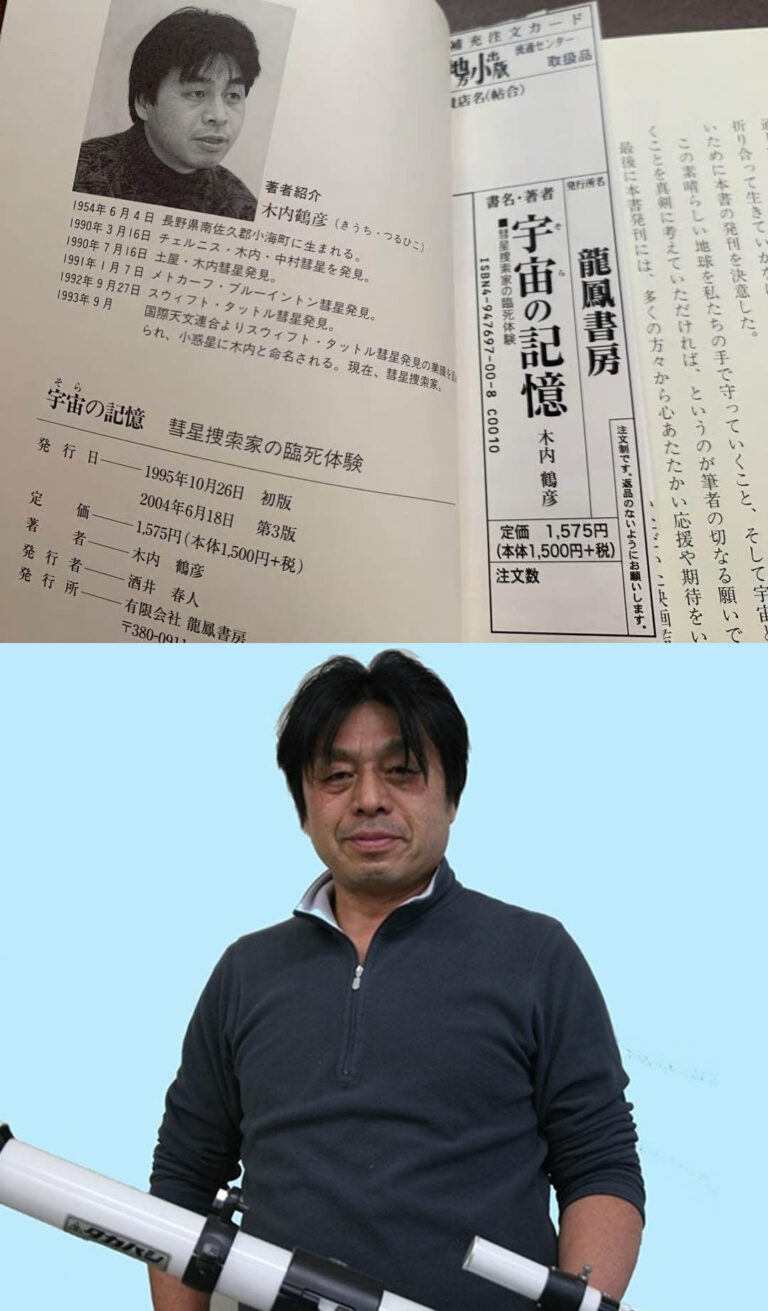
    Tsuruhiko wasn’t a random thrill-seeker or a conspiracy-loving eccentric. He was a respected astronomer and a prolific comet hunter in Japan. Over his career, he discovered four comets and even named one after himself. In 1992, he famously rediscovered Comet Swift-Tuttle, a celestial body unseen for over a century.

    Hunting comets isn’t for the faint of heart. It takes precision, patience, and scientific rigor. And Tsuruhiko had all of that. Beyond astronomy, he served as an officer in Japan’s Air Self-Defense Force and later became a lecturer. This was a man rooted in science — which makes his near-death experiences even more astonishing.

    Sadly, Tsuruhiko passed away in December 2024 at the age of 70, but his story continues to fascinate people worldwide.


    The First Near-Death Experience

    On that fateful night in 1977, Tsuruhiko was working as a flight operations dispatcher at Hiakuri Air Base when a sudden, severe abdominal pain hit him. Doctors diagnosed him with a rare and deadly condition: superior mesenteric artery obstruction, which blocked blood flow to his intestines. Despite their efforts, his heart stopped. He was pronounced dead.

    Thirty minutes passed. And then the impossible happened — Tsuruhiko’s heart started beating again, and he began to breathe. Medical staff were stunned. No one had survived this condition before, let alone revived after half an hour of clinical death.

    But the real shock came when Tsuruhiko began recounting what happened during those lost 30 minutes.


    Beyond the Body

    According to Tsuruhiko, as soon as his body gave out, his consciousness drifted into darkness. A distant glimmer drew him forward until it formed a tunnel, through which he entered a vivid, otherworldly landscape. Imagine standing barefoot in a vast meadow with flowers stretching as far as the eye could see — alive, solid, and serene despite having no heartbeat.

    By a white river, a small boat awaited him. He navigated it across using only his hands — no oars, no paddle, just intention. On the opposite shore, five strangers awaited him. One stepped forward, asking, “Why are you here?”

    To his astonishment, the four silent figures were his deceased relatives, and the woman guiding him turned out to be an aunt he had never met — she had died shortly after his birth.

    Before he could process this cosmic family reunion, he was suddenly back in his hospital room. Though still clinically dead, he could observe everything around him. His mother wept at his bedside. He saw her making calls to tell his sisters about his death, and — get this — he later recounted their conversation word-for-word after reviving.

    This wasn’t a hallucination. Somehow, his consciousness had been somewhere else, witnessing real events beyond the reach of his physical body.


    Time Travel and Memory

    His adventures didn’t stop with mere observation. He discovered that his awareness wasn’t bound by space — or even time. He could revisit past events.

    One memory that haunted him was a childhood near-accident by a river. During his NDE, he traveled back to that day and realized he himself had been the mysterious savior who had shouted “Look out!” and saved his sister from a rolling boulder.

    Then, he glimpsed the future. He saw himself giving lectures, teaching astronomy, and guiding young minds — events that unfolded exactly as he had “seen” them decades earlier. Yet, not all visions were comforting. He also saw a possible future of destruction and chaos, suggesting humanity’s path is not fixed.


    The Second Near-Death Experience and Proof

    In 2007, his life took another turn. While observing a solar eclipse in Shanghai, he suffered a severe stomach perforation and flatlined again. This time, he decided to attempt something bold: leaving tangible evidence of his journey.

    He traveled back 400 years to the late 16th century in Japan to the Tossa Shrine under construction. Using his consciousness, he influenced a carpenter to write a single word on a pillar: Turu — the first part of his name and the Japanese word for “crane.”

    After surviving surgery, Tsuruhiko visited the shrine. He found the faded inscription just where he remembered leaving it, and historical records noted that the word had mysteriously appeared centuries earlier. This, if true, was possibly the first verifiable proof of a near-death experience influencing the physical world.


    Cosmic Revelations

    Armed with these abilities, he explored even bigger questions. He projected himself back to prehistoric times and witnessed what he believed to be the cause of the great flood 13,000 years ago: a comet pulling ice from Earth’s poles, triggering global flooding. He even claimed that an advanced Atlantean civilization existed then, domesticated dinosaurs, and escaped to Venus before the flood.

    Finally, he ventured to the very beginning of the universe. He reported that instead of a fiery Big Bang, he encountered an infinite void containing a single great consciousness — what he called the Universal Mind. From this mind, all matter and energy emerged. Every individual consciousness, he concluded, is a fragment of this universal awareness, reuniting with it upon death.


    My Take

    Now, I’m not going to pretend his story is simple to swallow. Dinosaurs in 15,000 BC? Time-traveling inscriptions? Cosmic consciousness? Yeah… it sounds like sci-fi meets philosophy class. But here’s the thing: Tsuruhiko believed it. And sometimes belief backed by experience — even unverified — can inspire radical ways to think about life, death, and the universe.

    Sure, skeptics will chalk it up to hallucinations, DMT release, or overactive imagination. And yes, some of the physical evidence, like the Tossa Shrine inscription, remains unverified. But the ideas Tsuruhiko explored — consciousness beyond the body, time as fluid, a universal mind — resonate with philosophies, spiritual traditions, and even some emerging scientific theories.

    At the very least, his story challenges us to question what we think we know about reality. And if you’re like me, it makes you look at life with a little more awe… and a lot more curiosity.

    A Hundred Memories Episodes 11–12: What we learned in the end

    0

    A Hundred Memories ends with the Miss Korea pageant taking center stage — and not necessarily in a good way. The final two episodes pile on melodrama, bring back throwaway villains for one last scene, and force the main friendship to survive its worst test: poor timing and even poorer storytelling.

    Quick recap (so you don’t have to rewatch the cringe)

    First, Young-rye competes for Miss Korea — on behalf of the salon and for the scholarship cash. That steps on Jong-hee’s dream. Jealousy simmers. Tension grows. Then a familiar villain from Jong-hee’s past resurfaces with a knife and a grudge. Meanwhile, Jae-pil and Young-rye finally act like a couple while Jong-hee falls apart. The pageant ends in violence: Young-rye’s stabbed protecting Jong-hee. She falls into a coma. There’s a one-year jump. All ends “happily” on the beach. Cue the highlight reel.

    The character beats (short and blunt)

    • Jong-hee: She’s raw and human. Her pain feels real: a life that never quite settled, a friendship she lost, and an old wound that never healed. The actress sells it. The writing? Not always.
    • Young-rye: Earnest, forgiving, and kind. Her pageant speech is a direct address to Jong-hee — sweet and effective. She becomes the emotional center in the finale.
    • Jae-pil: Practically a comfort fixture. Their chemistry works. Still, the show skipped seven years we needed to see, so the relationship felt under-baked.
    • Mi-sook & the ex-boss: Plot devices more than people. They stir the pot, but their motivations are thin.

    What works

    • The rain confrontation scene: raw and painful. Jong-hee’s confession — that she gave Jae-pil up because of Young-rye and then resented what she lost — lands. It’s emotional and honest.
    • The pageant stage gives the finale a dramatic arena. The speeches are well-placed and meaningful. Young-rye’s answer about memory is the episode’s best emotional moment.
    • Performances: the leads carry what the script can’t. They make the messy moments feel human.

    What doesn’t work (and why it hurts)

    • Seven-year time skip. This is the big sin. Instead of showing growth, the show tells us what changed. Characters become strangers to us overnight. That kills emotional payoff.
    • Too many side plots. Random villains, sudden attempts on lives, and thrown-together vendettas clutter the main story. The central conflict — two women in love with the same person and the fallout — was enough. No need for extra noise.
    • A rushed ending. The one-year time jump after the coma robs us of the reunion and the apology scene Jong-hee desperately needed. Closure is told, not felt. That’s a storyline crime.
    • Missed opportunities. The show had a tight premise: workplace lives of women, friendship, rivalry, love. It wandered into high-drama detours and lost its way.

    Themes worth noticing

    • Memory vs. presence. The show keeps circling the idea that memories shape but don’t define us. Young-rye’s pageant line about wanting to relive bus attendant days to hug Jong-hee is the emotional thesis: you can’t catch the past, but you can show up now.
    • Friendship as loss and possibility. Jong-hee’s grief isn’t just romantic. It’s the mourning of a shared life and identity she once had. That’s a strong, relatable beat. The show just didn’t always let it breathe.

    Pacing and structure

    The tempo stumbles. The series starts grounded. Then it leaps seven years and expects suspension of disbelief. The finale rushes the healing arc. A steadier pace and fewer side-quests would’ve given emotional scenes room to breathe.

    Production notes

    • Costume and staging: the pageant visuals look good. Evening gowns, cameras, crowds — they give the finale the scale it wants.
    • Direction: some scenes (rain confrontation, the pageant speech) are framed well. Others go for melodrama and stay there.

    My take

    This could’ve been a tight, moving exploration of female friendship, choices, and regret. Instead, it turned into a mash-up of sensational plot points and hurried resolutions. The actors are excellent. The heart of the story is there. But the writers kept detouring into soapier territory and then skipping the very character work we wanted to see. At its best, A Hundred Memories gives you a real emotional moment. At its worst, it leaves you wondering why it wasted time on throwaway villains instead of staying with two complicated women.

    Suggestions the show should’ve taken

    1. Skip the seven-year jump. Show the slow fallout instead.
    2. Keep the stakes emotional, not violent. The love triangle and lost friendship were tension enough.
    3. Give Jong-hee her apology scene in real time. Let us feel the release, not get a time-lapse version of it.

    Final thoughts

    The finale has high points. The performances and a few stand-out scenes are worth watching. But the structural choices — time jumps and extra melodrama — dilute the emotional core. This wasn’t a disaster, but it’s a missed opportunity. I might remember the rain scene and Young-rye’s pageant line. Beyond that, the show asks us to trust a lot of off-screen development. That’s a gamble that doesn’t always pay off.


    Final verdict: ★★☆☆☆ (2 out of 5)

    Solid acting and a couple of strong scenes. Otherwise, a finale that leans on plot contrivances and time jumps instead of real emotional closure.

    Chew Jia Tian — The Singapore Nurse Who Drowned Saving a Kayaker

    0

    On October 22, 2023, between about 9:30 and 10:00 a.m., something awful happened off the south of Sentosa. Chew Jia Tian’s kayak flipped near a blue floating safety barrier. That spot was tricky — moving currents meet fixed barriers. It’s exactly the kind of place the sea likes to mess with you.

    Moments earlier, Jia Tian had paddled over to help another kayaker. His name was Lee Kuok Ming. His kayak capsized because the sea was uneven. She didn’t hesitate. She moved toward him to help.

    She put the other person first. That was her instinct. As Lee clung to a toggle rope on her kayak, Jia Tian tried to paddle them both away. But she got weaker. She told him, “Sorry, I can’t.” Lee let go and disappeared under the blue barrier into open water. He was later rescued by a passing craft. Jia Tian’s empty, capsized kayak showed up later. She did not.

    Two days later, her body was found in the waters off Sentosa. The autopsy said she drowned. Her life jacket had come off. She had rib fractures, but nobody could say how those happened. The coroner concluded the jacket itself was not defective: Jia Tian had buckled the side straps properly but had not fastened the crotch strap. The unused crotch strap was later found tucked away in her pockets.


    Who Jia Tian was — beyond a tragic headline

    She was 33. She trained as a nurse at the Singapore Institute of Technology. Quiet, polite, hardworking — the kind of person who leaves an “indelible mark” without seeking attention.

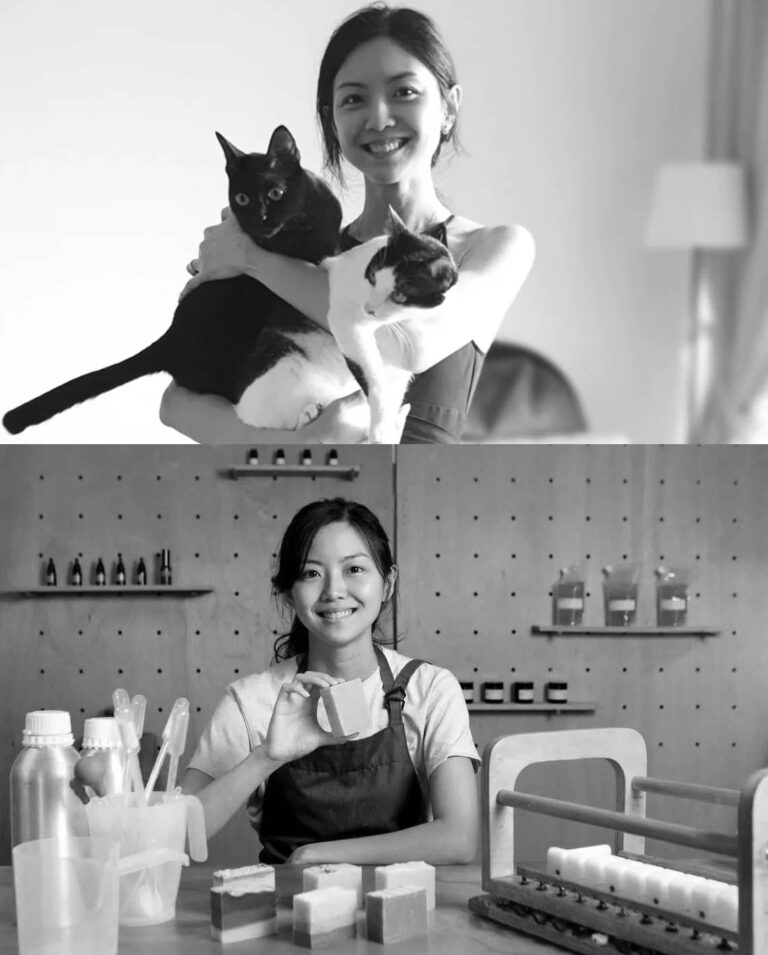
    She had been a nurse at Koo Teck Puat Hospital. Seeing her grandmother battle dementia changed her. It made her think about how to care for the elderly and their carers. It also nudged her toward a new path.

    Because she noticed how constant hand-washing dried out skin, she began to care about what went into skincare. That curiosity, plus family support, turned into Rough Beauty — a small Singapore business making natural, handcrafted bath and body products. Her brand wasn’t just about soaps and balms. It was her life philosophy bottled into pretty labels: slow down, care for body and mind, notice the little things.

    She ran Rough Beauty for nine years. She aimed to bring mindfulness into busy lives. She donated part of her business revenue to cat rescue groups. She adopted three street cats. One of her soaps even carried a cat’s name — Mari. She helped start and support the Toa Payoh North Cats. People who knew her remember her as down-to-earth. T-shirt and jeans kind of girl. Polite. Selfless. Always ready to help.

    After she died, her husband Ming and her sister Fang kept Rough Beauty running. They carried on the work she began.


    The final moment, and what it tells us

    She tried to save someone else. That choice defined her. The coroner called it “an act of pure selflessness.” It’s hard to argue with that.

    But this tragedy also highlights practical things we often skip when we think, “That’ll be fine.” Lifejackets work — if worn properly. The crotch strap exists for a reason. The sea can surprise even the careful. And sometimes, saving another person leaves no safety net for yourself.

    If you kayak, please do these three tiny but important things:

    1. Fasten every strap on your lifejacket — side and crotch. No shortcuts.
    2. Know the local currents and hazards before you go. Ask someone who knows the place.
    3. If you try a rescue, think about a plan that protects both of you. Call for help if you can. Don’t be a lone hero in strong currents.

    What Jia Tian left behind

    Her business. Her cats. A community that she quietly fed and supported. People who remember how kind she was. A husband and sister who now keep her mission going.

    She showed how one person can turn empathy into action. She also left us with practical reminders about safety and the fragile trade-off between helping others and taking care of ourselves.


    My point of view

    Here’s the blunt take. Heroes are real. But heroism shouldn’t require gambling with your life. You can admire bravery and still say: “Use your head, tie the strap.” We owe people like Jia Tian respect and proper memory — not posthumous risk-romanticizing.

    She chose to help. That choice is beautiful and terrible at once. Beautiful because it shows who she was. Terrible because simple precautions might have kept her here longer. Lifejackets aren’t props. Training in rescue techniques saves lives. If you care, do the small, boring things that let that care survive.

    Also: Rough Beauty matters. It reminds us that caring can be a job, a craft, and a way to connect with the people we love. Supporting her business now — through friends and family who kept it running — helps keep her values alive.


    How to honor her memory

    • Support local small businesses that carry on her work.
    • Donate to or volunteer at local animal rescues — she loved cats.
    • Learn basic water rescue and CPR. Practical skills beat good intentions.
    • Double-check safety gear before every trip. Teach someone else to do the same.

    Final words

    Jia Tian was a person who cared deeply. She acted on that care. She paid the highest price. That hurts. It should make us kinder. It should also make us smarter.

    When we remember her, let it be for her kindness and for the clear lesson she left behind: compassion without safety can end in tragedy. So be kind. But be safe too.

    Dr Pwee May Li (Emily) — Remembering a Devoted Singapore Family Physician

    0

    Emily was the kind of family doctor you hope to find: calm, present and genuinely interested in the people sitting across from her. She listened first. She examined carefully. Then she treated — not just the illness, but the human behind it.

    A senior family physician at Raffles Medical Group, Emily brought more than 25 years of practice to her patients. She blended up-to-date medical knowledge with an old-school, personal touch. Patients noticed. Colleagues noticed. Her practice reflected both skill and warmth.

    Emily trained at the National University of Ireland’s Faculty of Medicine. Ireland mattered to her. It’s where she met Jimmy in 1992 — a fellow med student who would later become her husband and a doctor at the National University Hospital. They married a few years after graduating and built a life together that quietly mattered.

    They discovered, oddly and sweetly, that their ancestral villages in China were only a ten-minute drive apart. Fate, it seems, likes small coincidences.

    Family came first. Emily and Jimmy had three children — Joshua, Elijah and Elizabeth. Two were born while Jimmy was studying in the United States in 2000. Emily put her kids at the center of her world. She even returned to Singapore a year early to sort out their schooling and make sure the transition was smooth. That’s the kind of planning that looks small at the time, but becomes everything later.

    At home she was attentive and steady. At work she was responsible and gentle. She rarely raised her voice. She was patient-centered in the purest sense: she cared about people, not headlines. Her father, Dr Pwee Hock Swee, a kidney specialist, helped inspire her love for medicine. Still, Emily never used that background to boast. She made friends easily and always kept the spotlight away from herself.

    Then, in 2022, life took a hard turn. Emily was diagnosed with ovarian cancer. Still, she kept showing up. She continued seeing patients because she wanted to be there for them in person. That decision says a lot about who she was. Work was not just a job. It was a calling.

    Cancer and treatment tightened family bonds. Dinner nights became sacred. Even when Jimmy traveled, the couple made time to travel together and make memories. They tried, as they said, to leave fewer regrets. That attitude wasn’t dramatic; it was steady. It was real.

    By 2025 she had recovered from cancer. Hope was real. But early October brought a sudden pneumonia after a fever and cough. Despite treatment, Emily passed away on 17 October 2025 at the age of 54.

    She leaves behind her parents, parents-in-law, Jimmy, their three children and the family pet, Pepper. People who knew her remember a selfless doctor, a devoted mother, and a grounded person who made others feel cared for.

    What she taught us

    • Be present. Emily listened. That alone healed a lot.
    • Choose steady love over loud gestures. Her life proves it.
    • Work can be service. She treated patients like people, not charts.
    • Make time for family. Small rituals matter more than big plans.

    My point of view

    Losing someone like Emily hurts because she gave out stability. In a world that applauds the loud, she was quietly consistent. That steadiness is underrated. It’s also contagious. When a doctor gives time and attention, patients feel safer. When a parent sacrifices small comforts for their children’s future, the payoff is lifelong. Emily modeled both.

    We often chase the dramatic forms of meaning — big trips, big achievements, the curated moments. Emily’s example pushes back. She shows that steady devotion, daily presence and quiet care build a life that matters more than applause ever could. If you want one practical lesson from her life: pick the small, important things and keep doing them.

    A short, honest note

    Tomorrow is not guaranteed. That’s uncomfortable to say, yes, but true. Emily and her family acted like that truth was real. They made dinners, traveled together when they could, and prioritized each other. That’s not morbid. It’s practical living.

    Farewell

    You’ll be missed, Emily. Thank you for the care you gave, the time you spent, and the quiet example you set. Rest well.

    My Tribute to Yap Shing Xuen

    0

    You were 17, Shing Xuen. Full of plans. Full of promise. Full of the ordinary kind of hope that teens carry — messy but bright. You loved volleyball and badminton. You were disciplined, thoughtful, and fiercely loyal to your family. Your laugh filled halls. Your smile lit up games. Your parents called you their heart walking outside their body. That little, perfect image of family joy.

    Then came October 14, 2025. You left home for school and never came back.

    On that day, the familiar classrooms and corridors of SMK Bandar Utama Damansara (4) turned into the site of a senseless, heartbreaking loss. In a moment that stole everything a family and a community had planned, you were attacked in a school restroom. You called for help. You hid. You fought. But it was not enough. By the time help arrived, you had been taken from this world.

    This should never have happened in a place meant for learning. Schools are supposed to be safe. They are where futures are built, friendships are made and laughter is loud. Instead, the peace of that campus was broken. A bright life was cut short. Friends and teachers now keep a seat empty where you once sat.

    To your parents, sister and family: no words can shrink the gap left by your absence. Every day from now on will carry echoes of what might have been. We grieve with you. We ache with you. We are so, so sorry.

    To your classmates: remember the laughter. Remember the games. Remember how she held the team together. Those memories are threads that will hold when the rest feels too heavy.

    To the school and authorities: this tragedy is a painful reminder that safety can never be an afterthought. It demands action. It demands honest review. It demands better protection for students, early intervention for troubled youth, and real resources for mental health and counselling.

    What Happened?

    On October 14, 2025, a 17-year-old student went to school as usual. In the school restroom, an unrelated fellow student attacked her. She sought help, but rescuers arrived too late. The incident left a school and a nation reeling. Friends are grieving. Teachers are shocked. Parents are furious and heartbroken.

    This is not just another news item. This is a real life. A family grieving a future. A school community forever changed. A teenager who will never finish exams, never celebrate the small wins, never argue with parents about curfew again.

    Loss like this leaves long shadows. Students will walk the corridors more slowly. Teachers will watch more closely. Parents will hold their children tighter. And yes — the world will ask the same questions over and over: Why? Could it have been prevented? Who failed?

    First, schools must be safe. That’s basic. Security measures, staff training, clear reporting channels, and quick emergency responses matter.

    Second, youth mental health cannot be ignored. When adolescents struggle — whether they are violent or vulnerable — early help can change outcomes. Counselling, peer support, and school-based mental health programs should be standard, not optional.

    Third, communities must stop pretending violence is a distant thing. It happens in our neighbourhoods, on school grounds, and among friends. We need better conversations, earlier intervention, and fewer excuses.

    This is painful and raw. I don’t want platitudes. I want action. Grief is real, and sympathy matters — but so does prevention. We must treat safety and mental health like public infrastructure: essential, funded, maintained. Schools cannot be islands. Parents, educators, counsellors, healthcare workers and policymakers must work together. And stop pretending tragedies happen to “other people.” They do not. They happen to our neighbours, our classmates, our children.

    If we care about the next generation, we must push for sensible, immediate change — not performative gestures. Fund school counsellors properly. Make security sensible, not scary. Teach kids how to ask for help. And when a student shows signs of trouble, act early and compassionately.


    A final note to Shing Xuen

    You were loved. You were seen. You mattered. Your parents’ grief is a wound that will never fully heal. But your life — brief as it was — touched people. It changed us. Let that change be toward better protection for others, so fewer families have to learn what your family is learning now.

    Rest in peace, Shing Xuen. Your team, your friends, your family — we will try to carry the light you brought into our lives.

    The Real Xu Na: Who was she?

    2

    Xu Na arrived in Singapore as a teen from northeast China. She came for school. At first, everything felt new and strange. It took her about six months to settle in. Slowly, she adapted. She discovered durians and liked them so much she used the fruit as a life metaphor: “Everything in life is like tasting durian. If you don’t try, you’ll never know what you’ll gain.”

    Here’s a simple table summarising key facts about Xu Na, drawn from available sources:

    CategoryDetails
    NameXu Na
    Age at death47 years
    OriginNortheast China → moved to Singapore in her teens
    Secondary & JCStudied in Singapore; attended Anglo‑Chinese Junior College (ACJC) — won the national Chinese composition competition in JC category in 1997
    UndergraduateBachelor of Computer Science at National University of Singapore (NUS), graduating around 2001
    PostgraduateMaster’s at NUS (~2003) and then Doctorate (PhD) at University of Cambridge (UK) in 2008
    Research workWorked as researcher at INRIA (French National Institute for Research in Digital Science & Technology) between 2009–2012
    Personal traitsDescribed as introverted, polite, intelligent; passionate about art/cooking; missed home deeply
    Family & homeLived with father in Singapore; mother died of lymphoma in 2016; family originally from China
    Date & circumstances of deathShe and her father were found dead in their flat at Block 324D Sengkang East Way, Singapore on 6 October 2025; father believed to have died earlier.
    Noted quoteWhile adapting in Singapore, she wrote: “Everything in life is like tasting durian. If you don’t try, you’ll never know what you’ll gain.”
    Possible issuesFormer classmates note her mental-health may have declined after her mother’s death and she became more isolated.
    Source: https://www.shinmin.sg/

    School wasn’t easy at first. English was a hurdle. She scored C6 in English at O-levels. Yet she did brilliantly in other subjects. After three months at Anglo-Chinese Junior College (ACJC), she wanted to stay. Her English score made that tricky. She appealed with help from her JC mathematics tutor — and won the place. She returned to ACJC and shone. Teachers remembered her as bright, humble and hard-working. In 1997 she placed first in a nationwide Chinese composition competition in the JC category.

    Xu Na pushed herself. She finished a bachelor’s degree in computer science at the National University of Singapore in three years, graduating in 2001. She later earned a master’s and then went on to the University of Cambridge. She completed a doctorate in 2008. Between 2009 and 2012, she reportedly worked as a researcher at INRIA, the French national institute for digital science and technology.

    Still, home called. While working in Europe, she missed Singapore and northeast China. She liked shovelling snow in winter, but more than that she missed family meals and Chinese New Year at home. She blogged about her mother’s cooking in 2010; her blog was active until 2013. She enjoyed cooking, painting and posted her art online. In student life she joined Chinese language groups and played table tennis. After university, though, she gradually lost touch with many classmates.

    Her family life took a hard turn in 2016. Her mother, a Singapore permanent resident, died of cancer. From then on, her father became her main support. Reports say the two kept mostly to themselves. Over the years Xu Na’s life narrowed to family, memories and small joys like food and painting.

    On 6 October 2025, Xu Na, 47, and her father were found dead at their home at Block 324D Sengkang East Way. Authorities believe her father died about a month before her. The discovery shocked those who knew of her achievements and gentle character. It was a tragic end to a life marked by academic success, international work and quiet humility.

    Behind the sad headline, Xu Na’s life had real depth. She was a scholar who climbed from a neighbourhood school to NUS, then to Cambridge and international research. She loved simple things — good food, painting, and memories of home. She kept to herself, but she left tracks: essays, blog posts, art and the memories of teachers and friends who called her sensible and well-behaved.

    This story is painful because it reminds us that success and solitude can exist side by side. High achievements don’t always mean a life without hurt. Grief can change a person’s path. Sometimes it narrows the world until only a few things hold meaning. That appears to have been part of Xu Na’s story.

    My point of view

    Xu Na’s life reads like someone who quietly collected wins: prizes, fast degrees, a PhD and research work overseas. Yet the human side — loss, loneliness, grief — is what connects this story to the rest of us. When a parent dies, everything shifts. People who seem the strongest can be the most fragile. That isn’t a failing; it’s human.

    We should take two simple lessons from this. First: check on one another. A short message, a food drop, a call — these things matter. Second: when someone achieves a lot, praise the wins, sure, but also ask: how are you doing? Achievement and mental well-being are not the same thing.

    If anything good can come from this sad news, let it be that we notice the people around us. Reach out. Offer practical help. Share a meal. Sometimes that is the durian moment — you have to try.

    Remembering Xu Na

    She kept her achievements private and her life simple. She loved durian. She loved family food. She loved art. She earned top academic honors and carried herself with humility. Today we remember those parts of her. May she rest in peace, reunited with her mother.