
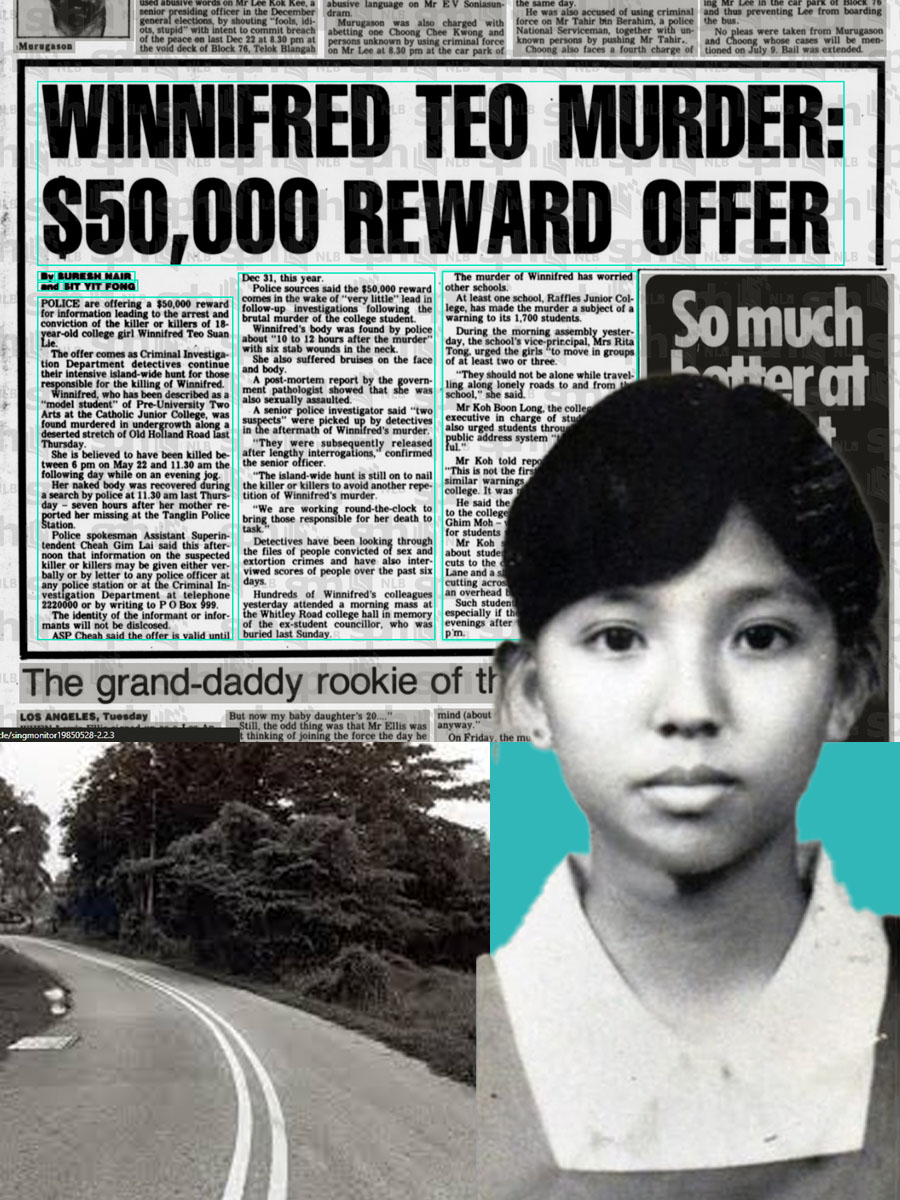

Some stories just refuse to fade, no matter how many years have passed. And the murder of 18-year-old Winnifred Teo is exactly that kind of story — haunting, heartbreaking, and painfully unfinished. Even today, people still talk about her with the kind of tenderness usually reserved for someone they actually knew. Maybe that’s because the details hit way too close to home. A young girl goes jogging near her place. A quiet, safe neighbourhood. A normal weekday evening. And suddenly, everything goes horribly wrong.
Back in 1985, Holland Road was basically jogger heaven. Quiet roads, fresh air, and a familiar route people trusted. And once you saw Winnifred — with her pink jogging shoes, black shorts, and long waist-length hair — you’d easily remember her. She was the friendly, sporty, always-smiling girl who somehow managed to be everywhere yet never once gave diva energy. Catholic Junior College students even described her as the “girl with Hawaiian looks,” which honestly sounded like the 80s version of calling someone effortlessly cool.
But on 22 May 1985, that easy evening routine turned into Singapore’s most chilling unsolved murder.
A Jog That Became Her Final Journey

Winnifred left home around 6pm to train for an upcoming adventure camp. No drama, no funny feeling, nothing out of the ordinary. Just a teenager jogging near her Maryland Drive home — something she’d done countless times.
But she never returned.
Her mother grew worried. Hours passed. By 4am, she made a police report. Something was clearly wrong.
A massive pre-dawn search began. It took six long hours before officers found her body hidden in deep undergrowth along Old Holland Road — barely 1.5km away from home. That detail alone still hurts. So near, yet impossibly far.
Her body was nude, covered in mud, and showed signs of a violent struggle. Her hands were tied with her own T-shirt and bra. Six stab wounds cut into her neck. Bruises marked her face and body. She had clearly fought hard — and likely against more than one attacker. Her trademark pink shoes and watch lay scattered nearby like silent witnesses.
The post-mortem confirmed the terrible truth: she had been raped and murdered, probably between 6pm and 7pm — within an hour of leaving home.
Imagine being her parents. Her classmates. Her community. For many, the shock never fully left.
A Daughter, A Friend, A Leader… Gone Too Soon
Before tragedy stole the spotlight, Winnifred was known for all the right reasons.
She was a student councillor, an athlete who played softball and volleyball, a natural leader who could get along with anyone. Teachers respected her. Friends adored her. She was even excited to become a godmother soon.
Her principal, Brother Joseph Kiely, once said she was such a credit to her parents that the whole school felt the loss like it was personal. And honestly, Singapore felt it too. When an 18-year-old girl with a bright future gets taken away so violently, the pain becomes collective.

Her father, a company director travelling in Munich at the time, rushed home immediately. But when asked for comments, all he could say was:
“Winnifred’s already gone… there is no point talking about it.”
And really, what else could any grieving parent say?
She was buried at the Choa Chu Kang Christian Cemetery on 26 May 1985. But heartbreak wasn’t done with the Teo family. Less than a year later, Winnifred’s young cousin Elaine passed away from a long illness. Today, both their ashes rest together — two young lives silenced too soon.
A Community Left Shaken
After her death, Singapore schools went on high alert. Teachers warned students — especially girls — not to walk alone, not to take shortcuts, not to travel on deserted roads. If you were a teenager back then, you definitely remembered the fear.
Joggers in the Holland Road area grew uneasy. Many admitted that women often jogged alone there. It was quiet, peaceful… maybe a little too quiet, in hindsight.
For police, the case quickly became an uphill climb. Despite intense investigations:
- A S$50,000 reward was offered.
- Two suspects were picked up and interrogated.
- Countless leads were followed.
Yet… nothing. No weapon. No suspect. No answers.
The killer — or killers — simply vanished.
My Take: Why This Case Still Stings Today
Alright, here’s where I spill a bit of my own thoughts — because after reading through this entire case, I couldn’t help feeling something.
Winnifred’s case still hurts because it breaks the “Singapore bubble.” We’re so used to safety that stories like this feel unreal. Almost like: “Wait, something like this actually happened here?” That shock becomes part of the trauma.
Another thing? She did everything right. She jogged before sunset, stayed in her neighbourhood, used a familiar route. And still — tragedy found her. That’s the part that always gets people.
Also, the fact that it remains unsolved? Wah, that one is the ultimate itch you cannot scratch. No closure for her family. No justice. No answers. It just hangs there, year after year, like an unfinished sentence.
Personally, I feel her case deserves more attention today, not less. Not for morbid curiosity, but because forgotten cases eventually lose pressure, and when pressure fades… so does the chance for answers. Cold cases don’t solve themselves, but public memory can help.
And maybe, just maybe, someone out there still knows something.
A Loss Singapore Never Forgot
Winnifred Teo isn’t just a name in an old crime report. She was a daughter, a friend, a teammate, a student leader, and someone with a future so bright it practically glowed.
Her life was taken in a way that still shakes people decades later. Her story remains one of Singapore’s most haunting unsolved murders — not because of how gruesome it was, but because of how human she was.
And until answers come, her memory remains a quiet reminder: life is fragile, and justice is not guaranteed.