

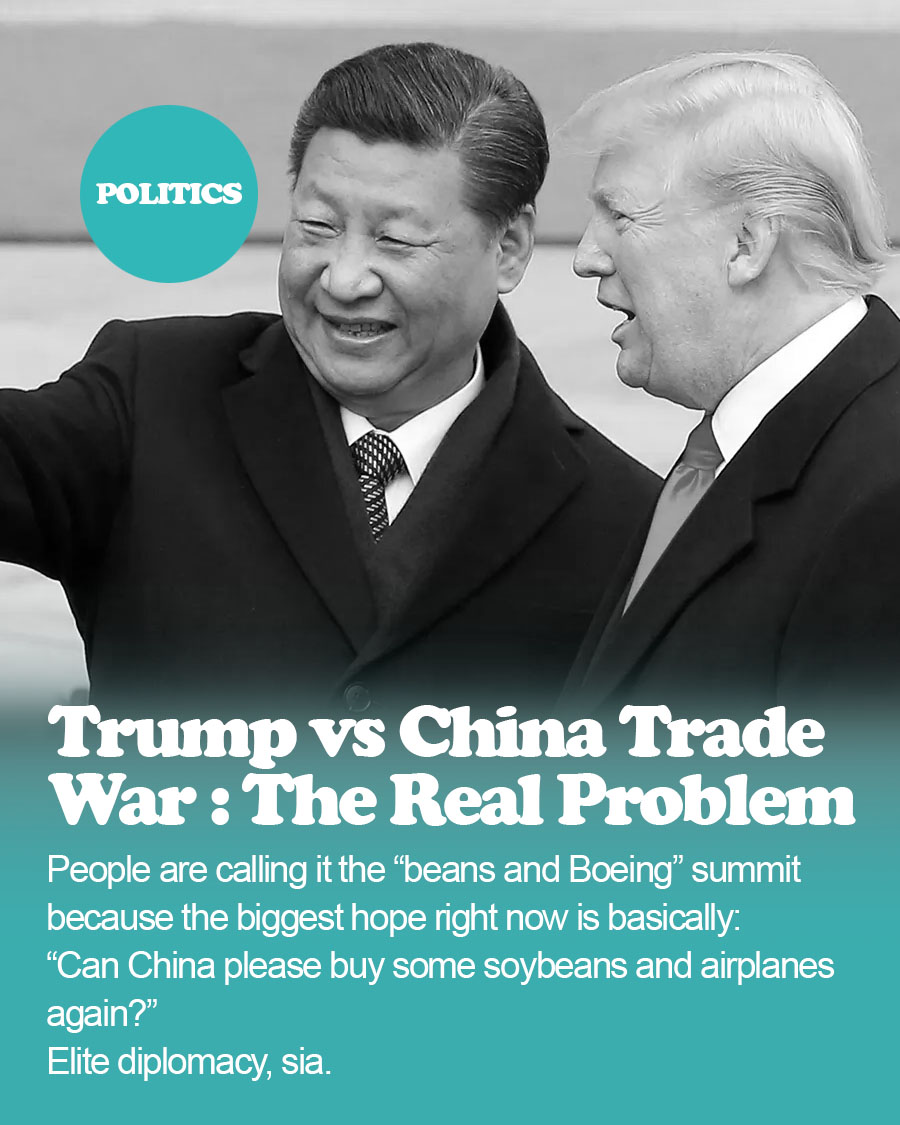

Every few years, America and China gather for another dramatic summit. Same energy every time. Two world leaders walking slowly past giant flags like they’re entering the final boss level of a video game. Smile for camera. Shake hands. Say “productive discussions.” Then everybody flies home and pretends the global economy is not held together with duct tape and vibes.
This week, Donald Trump and Xi Jinping are meeting again in Beijing. And honestly? Expectations are so low they’re practically underground parking.
People are calling it the “beans and Boeing” summit because the biggest hope right now is basically:
“Can China please buy some soybeans and airplanes again?”
Elite diplomacy, sia.
But underneath all the headlines, tariffs, and political chest-thumping, there’s a much bigger issue nobody explains properly. Not because it’s impossible to understand. Actually, it’s surprisingly simple.
The real fight between America and China is not just politics.
It’s accounting.
And once you see it, you cannot unsee it.
First, Let’s Talk About The Tariff Drama
Last year was basically economic WWE.
America slapped tariffs as high as 145% on Chinese goods. China fired back with tariffs up to 125% on American products. Then both sides started restricting important exports like rare earth minerals.
You know, those tiny magical materials inside everything from EVs to smartphones to military tech.
Basically, modern life runs on these things. Your vacuum cleaner also involved somehow. Humanity truly peaked there.
Eventually, both countries reached a temporary 90-day truce because they were honestly running out of things to tariff already. Like two angry people in an argument who already brought up every issue from 2014.
But here’s the thing.
Tariffs are not fixing the actual problem.
They’re just expensive shouting.
China’s Economic Model Is Hitting A Wall
China became an economic monster by making things cheaper and faster than almost everybody else.
For years, that strategy worked beautifully.
Factories exploded.
Exports exploded.
Infrastructure exploded.
GDP numbers looked absolutely insane.
The whole world looked at China like:
“Wah lao. These people speedrunning industrialization.”
But now there’s a problem.
China produces far more than its own people can afford to consume.
That sounds weird at first, right?
“How can a country make so much stuff but still struggle?”
Easy.
Because ordinary households in China don’t get enough spending power compared to how much the country produces.
The government heavily supported manufacturing and investment for decades. Great for factories. Great for exports.
Not always great for regular consumers.
So what happens?
The country keeps producing mountains of goods… but domestic demand cannot absorb all of it.
Meaning those products MUST go overseas.
That’s why China depends so heavily on selling to the rest of the world.
Especially America.
Trade Is Supposed To Be Give-And-Take
This is where things become unintentionally hilarious.
Traditional trade works like this:
You sell stuff abroad.
You earn foreign money.
Then you use that money to buy things from other countries.
Simple.
Like going to a pasar malam. You cannot just keep selling ramly burgers forever without buying anything else from the market leh.
But China increasingly wants to produce almost everything domestically.
One Financial Times writer asked Chinese economists:
“What does China actually want to buy from the rest of the world?”
The answer was basically:
“Nothing much.”
That is… not how healthy trade relationships work.
Because eventually your customers run out of money.
Imagine a bakery that becomes so aggressive it destroys every butcher, brewer, and candle shop in town.
Congrats.
Now nobody can afford your bread anymore.
Amazing strategy. Confirm-plus-guarantee self-own.
America Became The World’s Shopping Cart
Now we get to the part politicians almost never explain properly.
When countries like China, Germany, or Japan save enormous amounts of money and generate huge trade surpluses, that excess money needs somewhere to go.
And guess where it goes?
America.
Why?
Because the US financial system is still the deepest and safest giant parking lot for global money.
So foreign countries buy US assets.
US bonds.
US debt.
US stocks.
But there’s a catch.
Actually, it’s not even a catch. It’s math.
If foreign money flows massively into America, the US ends up running trade deficits almost automatically.
That means America imports more than it exports.
Not because Americans are lazy.
Not because China is “winning.”
Not because somebody tweeted badly at 2am.
It’s baked into the system.
America basically became the world’s consumer of last resort.
Everybody sells to America.
America absorbs the excess.
Americans keep buying.
The global economy became one giant version of:
“You pay first lah. I transfer you later.”
The Problem With Cheap Stuff
For years, Americans benefited from this arrangement.
Cheap electronics.
Cheap furniture.
Cheap clothes.
Cheap everything.
Consumers happy.
Inflation lower.
Corporate profits booming.
But the bill eventually arrives. Like Grab surge pricing after a concert.
Because when foreign imports crush domestic industries, something has to absorb the damage.
Usually it becomes:
- Higher household debt
- Bigger government deficits
- More financial bubbles
- More inequality
- More political anger
Sound familiar?
That’s basically modern America.
And now even the US government itself is drowning in debt while trying to fight inflation, fund military operations, subsidize industries, and maintain global dominance all at the same time.
That’s not economic strategy anymore.
That’s a man carrying six bubble teas with one hand and pretending everything stable.
Europe Also Getting Cooked
Europe meanwhile is dealing with its own chaos.
Cheap Chinese electric vehicles and electronics are flooding European markets. At the same time, European businesses are drowning in regulations and bureaucracy.
One survey found German firms hired hundreds of thousands of workers mainly just to handle compliance paperwork.
Imagine graduating university only to spend your life filling forms nobody reads.
Peak modern civilization.
Now Europe wants Chinese companies to:
- hire European workers
- use European components
- transfer technology
Which is funny because China literally used the same strategy against Western companies years ago.
Now China seeing Europe copy homework and suddenly acting offended.
The geopolitical irony here is Michelin-star level.
Between You & Me
Honestly, both America and China are trapped in systems they created themselves.
China cannot easily boost domestic consumption because that means giving ordinary households more economic power and reducing state control.
America cannot easily reduce trade deficits because the entire global financial system depends on US markets absorbing excess capital.
So politicians do what politicians always do.
They perform.
Tariffs.
Summits.
Committees.
Big speeches.
Dramatic headlines.
But the structural problems remain untouched.
It’s like spraying Febreze in a room with a leaking ceiling. Smells fresher for five minutes. Ceiling still collapsing, bro.
And here’s my slightly controversial take.
A lot of countries secretly loved globalization when it benefited them. Now everyone suddenly shocked that dependency cuts both ways.
China depends on foreign buyers.
America depends on cheap imports.
Europe depends on Chinese manufacturing while pretending it doesn’t.
Everybody interconnected until geopolitics enters the chat.
Then suddenly everyone remembers “national security.”
Funny how that works.
Trump’s Problem Right Now
Here’s the awkward part for Trump.
His biggest weapon, tariffs, keeps getting smacked down by US courts.
One set got blocked.
Then another set got ruled illegal too.
So he’s heading into negotiations with weaker leverage than before.
At the same time:
- inflation remains stubborn
- approval ratings are shaky
- elections are coming
- businesses hate uncertainty
Even members of his own party reportedly celebrated when tariffs got blocked.
That’s rough.
Nothing says “strong negotiating position” like your own teammates quietly cheering against your strategy.
China Is Buying Time Too
China also knows its economy has vulnerabilities.
Huge property crisis.
Youth unemployment.
Aging population.
Semiconductor dependence.
Weak domestic demand.
So Beijing mainly wants time.
Time to strengthen its tech sector.
Time to reduce reliance on Western technology.
Time to build resilience.
America wants time too.
Time to rebuild manufacturing.
Time to secure rare earth supply chains.
Time to reduce dependence on China.
So this summit is less about solving problems and more about delaying disaster politely.
Diplomatic procrastination, basically.
The Scary Part Nobody Wants To Say Out Loud
Historically, global trade imbalances usually end in one of two ways:
- Countries cooperate and adjust peacefully.
- Crisis forces adjustment violently.
Guess which one humans are historically better at.
Yup.
The worrying part is that today’s world feels less cooperative than previous eras.
Everyone is more nationalistic.
More suspicious.
More politically divided.
More economically stressed.
And unlike the 1990s, nobody really trusts anybody anymore.
Not exactly ideal conditions for calm global coordination, lah.
So What Happens Next?
Most likely?
More temporary truces.
More negotiations.
More tariffs.
More “historic” summits.
More committees with extremely important sounding names.
But unless the underlying economic structure changes, the imbalance stays.
China will keep producing more than it consumes.
America will keep absorbing more than it should.
Europe will keep regulating itself into emotional damage.
And the rest of the world will continue pretending this arrangement can last forever.
Spoiler alert:
Forever got expiry date one.