



The internet is nothing if not predictable in its unpredictability, and once again, it has outdone itself. Just when you thought you’d seen every possible headline that could make your jaw drop, enter: Lil Tay. Yes, that Lil Tay. The once self-proclaimed “youngest flexer of the century” has now reemerged to make headlines for a very different reason. And oh boy, did she bring the internet to its knees.
Let’s rewind a little. It’s been a while since we heard anything major from Lil Tay. After all, her presence had slowly faded following the bizarre hoax about her death in 2023, followed by allegations of family drama and confusion surrounding her age. So, when the rapper-turned-social-media-phenomenon suddenly popped back up in July 2025, the world didn’t quite expect this kind of comeback.
TL;DR
- Lil Tay launched an OnlyFans account on her 18th birthday, claiming to have earned over $1 million in just three hours.
- The move sparked a major online debate about the ethics of child stars transitioning into adult content and the role of the audience.
- The article questions the commodification of youth and the public’s demand for such content, calling it “fetishization” rather than fandom.
A Birthday Surprise No One Saw Coming
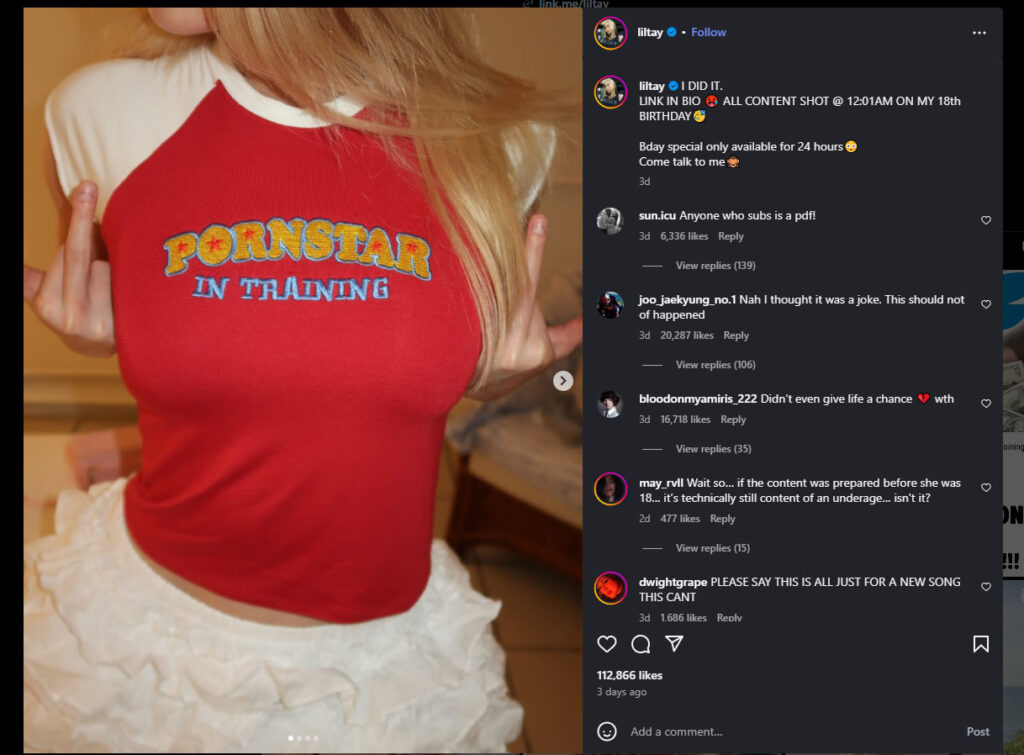
On July 29, Lil Tay turned 18. Instead of throwing a low-key birthday bash, she decided to do what any legally adult internet-savvy influencer might do these days: she launched an OnlyFans account. Within hours, she claimed to have shattered the platform’s record for earnings in a single launch. And when we say shattered, we’re talking “mic-drop, leave-no-survivors” kind of shattered.
Lil Tay posted to Instagram donning a shirt that read “Pornstar in Training,” accompanied by a caption advertising a “birthday special” for 24 hours only. Her OnlyFans page offered subscriptions at $19.99 per month, promising exclusive content, access to DMs, and photos of her “birthday suits.”
The Money Machine Goes Brrr
Here’s where things took an even wilder turn. Less than a day after her OnlyFans debut, Tay shared a screenshot of her earnings, claiming she raked in over one million dollars in just three hours. Let’s break that down:
- Subscriptions: $511,003.79
- Private messages: $486,558.11
- Tips: $26,736.19
Total: $1,024,298.09
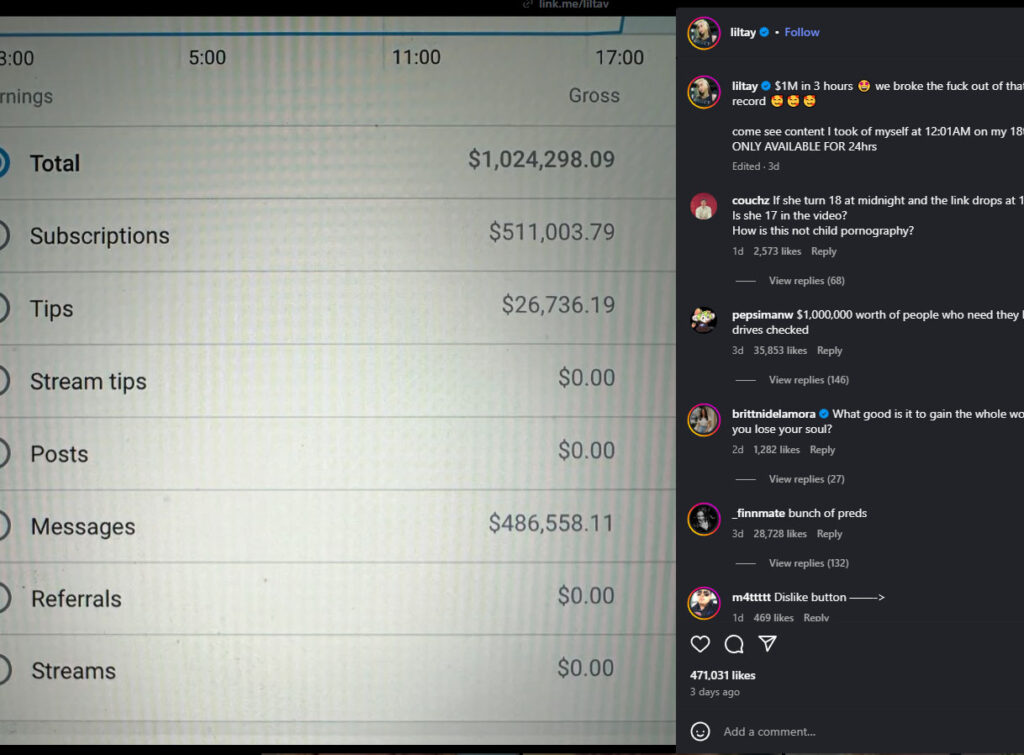
All of this happened in three hours, allegedly. While we can’t independently verify the numbers, the screenshot Tay posted seems to align with the platform’s dashboard layout. Whether or not she truly broke records set by other OnlyFans celebrities like Bhad Bhabie or Bella Thorne remains up for debate, but the buzz alone is enough to fuel the fire.
The Ick Factor
Now let’s talk about the elephant in the digital room. There’s something undeniably unsettling about this entire situation. While it’s technically legal for someone aged 18 to join platforms like OnlyFans, the timing here feels deliberately engineered for maximum shock value. Tay, who has been in the public eye since she was 9 years old, has grown up in front of millions. Many have seen her as a child for so long that this sudden leap into adult content territory feels…off.
The optics of going from child star to adult content creator literally overnight create a weird, morally gray zone. A lot of people aren’t questioning her legal right to do it. They’re questioning why so many people were seemingly waiting in the digital wings, ready to pay the moment the clock struck midnight on her birthday. That’s the part that feels gross.
The Public Backlash
Comments on her Instagram page reveal a mixed bag of reactions. Some fans congratulated her, others showed genuine concern, and a few called it what it is: creepy. The overwhelming sentiment was clear—just because you can do something doesn’t always mean you should. Especially when your audience still mentally pictures you as a child influencer with a bad attitude and a whole lot of cash.
And to be fair, Tay isn’t the first to take this route. There’s a growing trend of young celebrities or influencers opening OnlyFans accounts the moment they turn 18. Bhad Bhabie, for instance, made headlines for earning over $1 million in her first six hours on the platform. Yet even then, people questioned the ethics surrounding it.
The Power of Fame and Controversy
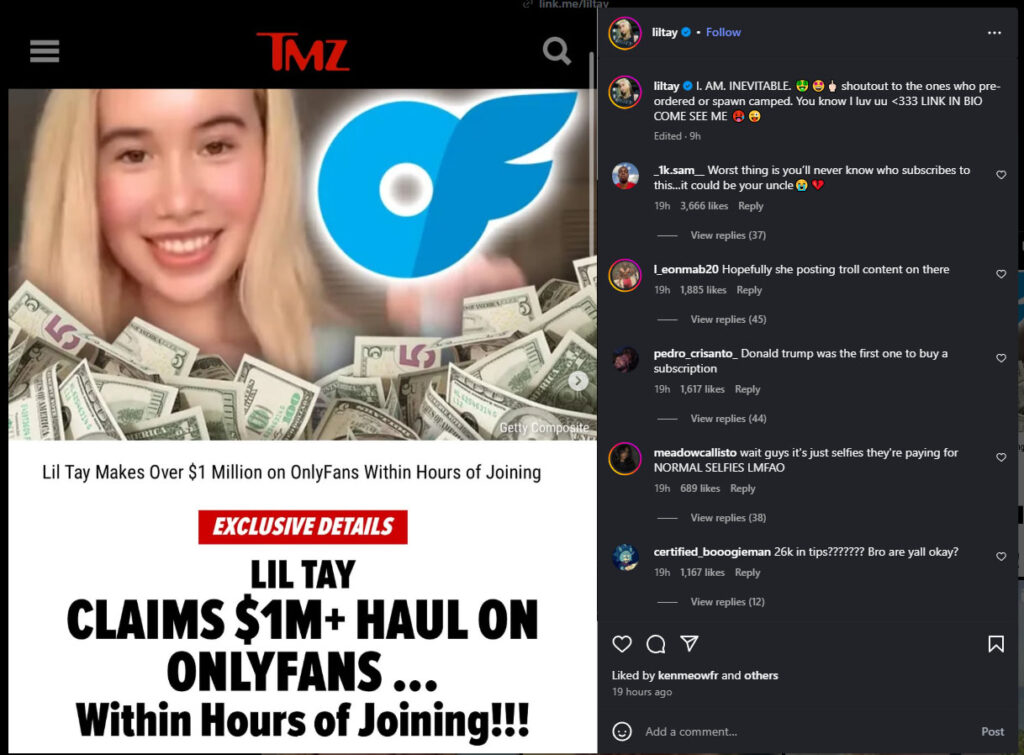
Fame has always had a complicated relationship with youth, especially when it intersects with platforms that commodify attention and desire. Lil Tay’s case is particularly jarring because she was marketed as a child for so long. From flexing stacks of cash to being embroiled in family drama and even death hoaxes, her rise (and fall, and rise again) has always felt chaotic.
And now? She’s choosing to monetize the very thing people have been talking about since the beginning: her image. It’s not about music anymore. It’s about shock, access, and the economics of being barely legal.
The Bigger Question: Who’s Really at Fault?
It’s easy to point fingers at Tay, but maybe we need to take a hard look at the audience. Who are these people spending massive amounts of money on her content within hours of her turning 18? Why is there a market for this at all? The speed and volume of the response suggest that there’s a deeply problematic demand lurking just beneath the surface of our digital culture.
We need to consider how parasocial relationships, online voyeurism, and digital accessibility have changed the way people interact with celebrities—especially young ones. There’s something deeply disturbing about waiting for a public figure to become of age just so you can consume their adult content. That’s not fandom. That’s fetishization.
My Take on This Circus
Alright, time for a little straight talk. Lil Tay is no fool. Whether you find her brand distasteful or genius, you can’t deny she knows how to stir up a spectacle. She’s monetizing her transition into adulthood in the most profitable way possible. She knows controversy sells, and she’s cashing in big time.
But let’s not pretend this isn’t exploitative. Yes, she’s technically an adult. Yes, it’s her choice. But given her history, the narrative feels more like the internet grooming her for this moment than her organically choosing it. The moment feels less like empowerment and more like a transaction.
And no, this isn’t about slut-shaming or moral policing. It’s about questioning the systems and people that cheer on, or worse, wait for, this exact transformation. That’s the part that gives me chills.
What Happens Next?
Lil Tay might ride this wave into financial freedom, or she might face burnout from the relentless pace of internet fame. Either way, this moment marks a sharp pivot in her story. Whether it becomes a cautionary tale or a case study in modern digital marketing remains to be seen.
For now, she’s enjoying the cash, the controversy, and the clout. But as we’ve seen time and time again with young stars thrust into the adult spotlight, the glare of fame can be just as blinding as it is lucrative.
Final Thoughts
This isn’t just about Lil Tay. This is about us—the audience, the media, the platforms that enable and reward this kind of spectacle. As long as there’s a profit to be made, there will be someone willing to step into the spotlight. But maybe it’s time we ask ourselves why we keep tuning in.
Because if we don’t start drawing ethical lines somewhere, we’re going to keep sliding into darker and darker territory, all under the shiny banner of “content.”