

More
    Home Blog Page 8

    Google’s 2025 ‘Year in Search’ Video Backfires Online

    0

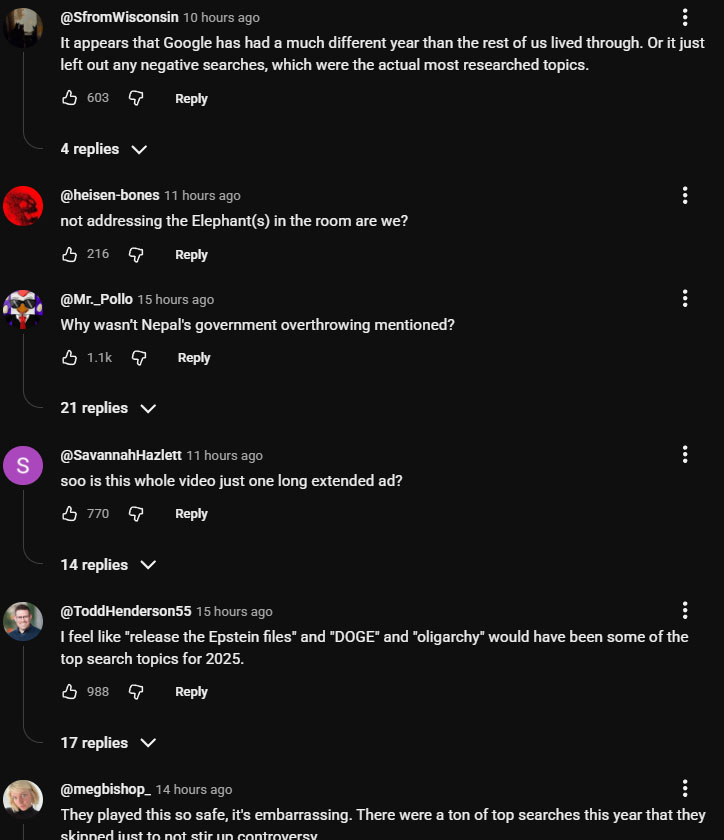
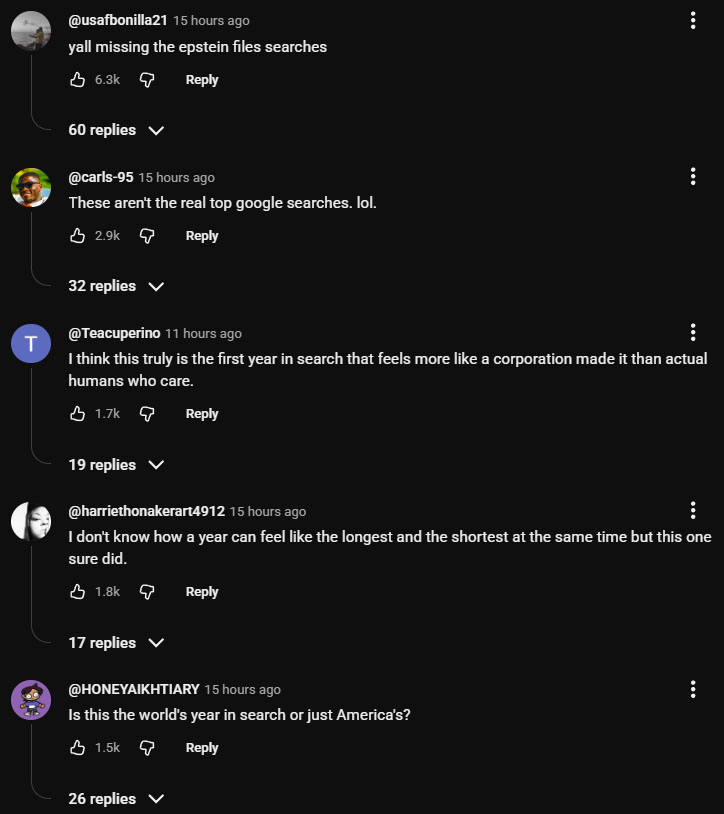
    Google dropped its shiny new Year in Search video for 2025 on Monday, and wah, the internet reaction ah… not very glam. Usually, this annual video is a crowd-pleaser. You know the drill: emotional moments, big world events, pop culture highs, and that one clip that makes everyone suddenly “have dust in their eyes.”

    But this year?
    Aiyo. Different story. And not in a good way.


    What Google Did Show

    As always, the video opened with its usual montage of pop culture favourites — Lady Gaga here, Lububus there, all the feel-good vibes. Then, halfway through, the video suddenly swerved into what looked like… an ad for AI. Not surprising, since tech companies now treat AI like the golden child who can do no wrong.

    “California Fires” – Google’s 2025 ‘Year in Search’

    We also got dramatic clips from the Southern California wildfires, Trump shaking hands with first responders during the Central Texas floods, and Erika Kirk talking about “courage” and “family” during the service for her late husband, Charlie Kirk.

    So yes, the video packed a punch. Just… maybe not the right one.


    What Everyone Noticed Was Missing

    And this is where internet users started flipping tables.

    Many YouTubers and commenters pointed out that the video conveniently skipped:

    • The war in Ukraine
    • The war in Gaza
    • The conflict in Sudan
    • Trump’s immigration crackdown
    • The massive “No Kings” protests
    • Basically… a whole chunk of global reality

    One user summed it up beautifully with peak internet energy:
    “Charlie Kirk in there but nothing about Gaza bro are we fr 😭😭”

    The shade is real.

    Another YouTuber, @megbishop_, called the video “embarrassing” and accused Google of purposely skipping top searches just to avoid controversy. Honestly, why Google act like we all forgot what we searched this year? Our search history is chaotic but not that chaotic lah.


    Why People Are Annoyed

    “The first American Pope” – Google’s 2025 ‘Year in Search’

    Look, year-end recaps are supposed to reflect what mattered to people. The joys and the difficult stuff. The wins and the heartbreak. It’s like curating a photo album for the whole planet — you can’t just crop out everyone you don’t like.

    This year’s version feels a bit like your friend who posts a super-filtered IG story of their “amazing year” but conveniently leaves out the drama, the breakups, and the chaos. Nice try, but everybody knows.

    The internet isn’t asking for Google to become a news agency. But if you’re calling it a “Year in Search,” then at least acknowledge what people actually searched lah.

    Honestly, the video feels like Google trying to maintain “good vibes only” while sweeping the messy stuff under the carpet. But come on, 2025 wasn’t exactly a soft, gentle year. The world was burning — literally and figuratively.

    People didn’t want a PR gloss. They wanted honesty.
    Even a short nod to the heavy topics would have shown respect to the people affected.

    Also, when a recap video looks more like a marketing push for AI than a reflection of human reality… ya, people will call it out. And they did. Loudly.

    To be fair, it’s tough for a huge company like Google. Anything they include or exclude will spark debate. But this year just feels extra disconnected, like someone clicked “mute” on the world and “boost” on the brand campaign.

    The 2025 “Year in Search” video isn’t terrible. It’s just… incomplete. And people don’t like their lived experiences being edited out. Understandable lah.

    Will Google tweak things next year? Hard to say. But one thing’s for sure — the internet never misses a beat, and they definitely didn’t miss this one.

    Yoong Kok Kai: Crashed into Tuas Checkpoint Officer

    0

    “Every time I walk past Yi Shu’s BTO, I look at it and think, this could have been his life. But he was robbed of it.”
    Alex Ng, elder brother of Ng Yi Shu

    That one line already hurts enough. But the reality behind it? Much worse.

    There are no more replies from Yi Shu.
    No more texts.
    No more quick jokes.
    No more “ok lah, later I call you.”

    He cannot walk.
    He cannot communicate.
    He doesn’t even respond when someone calls his name.

    His body is here, but the young man everyone loved — the cheerful, loud, always-ready-to-help guy — is trapped inside, unable to come back out.

    The Crash That Changed Everything

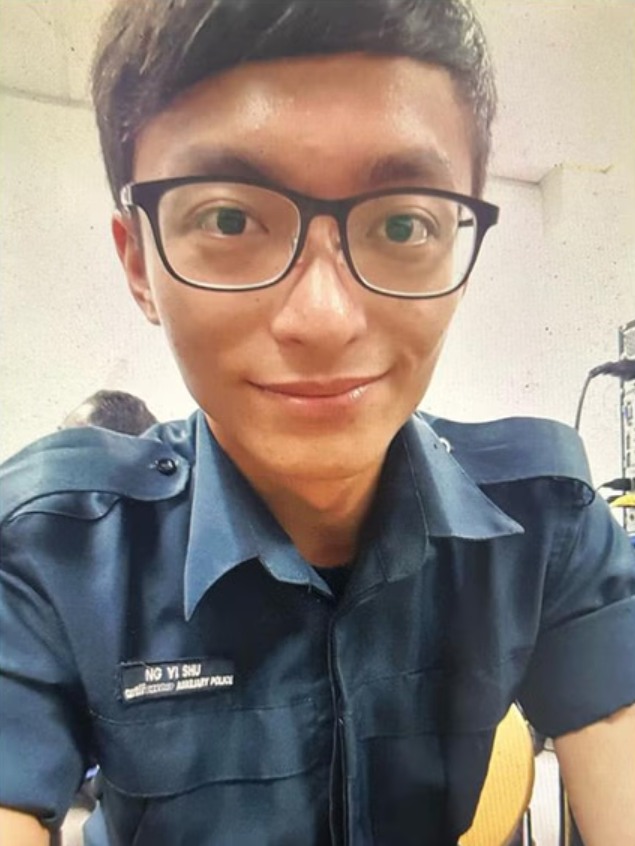
    On 24 March 2023, auxiliary police officer Ng Yi Shu, then 28, was on duty at Tuas Checkpoint. It was supposed to be a normal shift. Same uniform, same responsibility, same purpose: keep people safe.

    But in one split second, everything collapsed.

    A car driven by Yoong Kok Kai, then 42, came speeding towards the observation post after he lost control of his Lexus. The impact was so violent that it uprooted the safety bollard, the gantry, the barrier — even the traffic light.

    Imagine the force needed to rip all that out of the ground. Now imagine being a human standing behind those things for protection.

    Yi Shu ran behind the bollard and gantry, hoping they would shield him.

    They didn’t.

    The crash left him with severe traumatic brain injuries and multiple facial fractures. He survived, but the life he knew ended on that very spot.

    Twelve Surgeries. Endless Heartache.

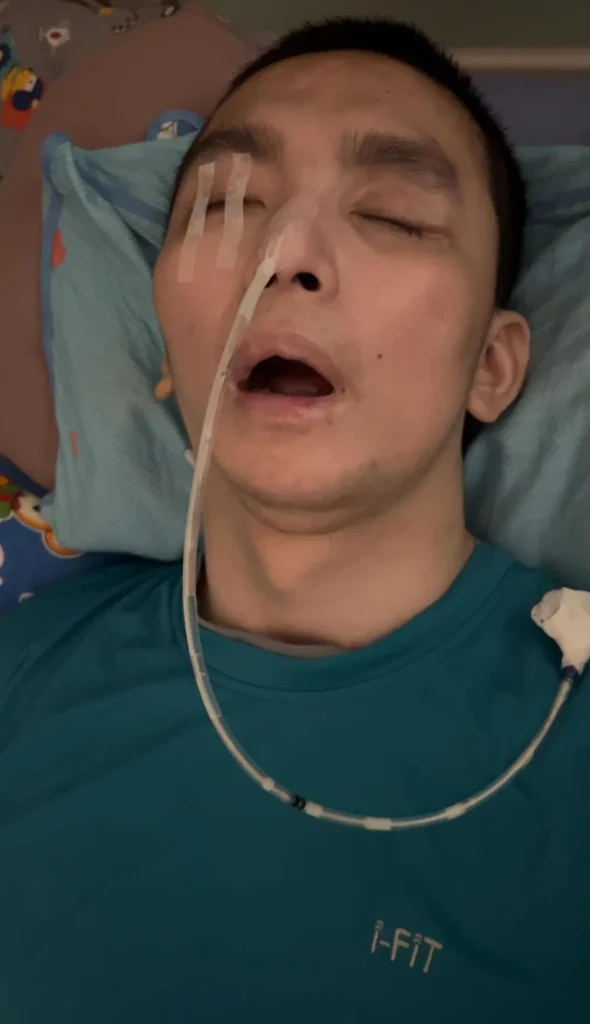
    In just three months, he went through 12 major operations. Today, he lives permanently in a nursing home in Jurong West, bed-bound and in a vegetative state.

    He is only in his late 20s.

    Source: https://www.facebook.com/DeathKopitiamSG

    His 64-year-old father quit his job as a freelance driver to become his caregiver. Every morning, he travels to the nursing home and stays the whole day. He massages his son’s legs. He cleans his face. He talks to him even though there’s no reply. He eats lunch beside his son, hoping he feels less alone.
    This is love. But it is also heartbreak, repeated daily.

    A Family’s Future, Ripped Away

    When the crash happened, the family could barely recognise him. And honestly, they still struggle.

    Yi Shu used to be the one who brightened the room. Funny, optimistic, easygoing — the kind of guy everyone wanted as a friend.

    He and his girlfriend of five years were getting ready to pick up their new BTO keys in Boon Lay. They were supposed to plan their renovation, argue about tiles, get married, start a family, and build the kind of future young Singaporean couples dream of.

    Now?

    Those dreams are gone.

    His girlfriend continued texting him for months, sending him messages as though he could read them, hoping maybe one day he would reply.

    But no reply came. And no reply ever will.

    Eventually, the family told her it’s okay for her to let go. She deserved a future too — a real one, not one stuck in grief.

    Letting go doesn’t mean she loved him less. It means life forced her hand.

    Meanwhile, the Driver Walks Away Far Easier

    Source: Straits Times

    Yoong was sentenced to 5 years in jail. After that, he can pick up his life again.

    But for Yi Shu and his family, the “sentence” is forever.

    Their suffering didn’t end at the court. Their suffering restarts every morning.

    A Pain With No Expiry Date

    The crash on 24 March 2023 was just one moment in time. But the consequences will last until the last days of those who loved him.

    Every day is another reminder of what was taken.
    Another reminder of the life that could have been.
    Another reminder that fairness doesn’t always show up.

    For Yi Shu, the tragedy didn’t just strike once — it continues, hour by hour, breath by breath.

    And for his family, every visit, every memory, and every silent room is a constant echo of the son, brother, partner, and friend that they lost — even though he is still physically here.

    A whole future erased in seconds. A lifetime of pain left behind.

    Senseless. Heartbreaking. And absolutely preventable.

    THE OBSESSION OF “BLACK CAT” — The Murder of Korean Streamer Yoon Ji-ah

    0

    A Streamer Who Felt Like a Friend

    Yoon Ji-ah wasn’t just another Korean influencer. With more than 300,000 followers and live streams that felt like cozy late-night chats, she had this magical ability to make viewers feel like they knew her. She was sincere, playful, and refreshingly real — the kind of streamer who made you stay “just five more minutes” before bed.

    But on September 11, 2024, during what appeared to be a completely normal live stream, she signed off… and vanished. Within hours, South Korea was thrown into a frantic search. What unfolded next was a chilling story of obsession, money, manipulation — and ultimately, murder.


    2. Yoon Ji-ah: The Rising Star

    2.1 Warm, Charming, and On the Rise

    Despite her young age, Yoon Ji-ah had already crafted a strong online presence:

    • Comedy skits
    • Fashion and lifestyle videos
    • Day-in-the-life vlogs
    • Intimate, friend-like live chats

    Offline, she dreamed of becoming an actress. Her friends described her as hardworking, ambitious, and full of hope.

    2.2 The Power of Parasocial Connections

    Her streams didn’t just entertain — they offered comfort. She laughed, chatted, and opened up about personal struggles. Fans responded with virtual gifts, including the iconic Korean “star balloons” on AfreecaTV.

    Most gifts were harmless.
    One was not.


    3. Enter “Black Cat”: The Donor Who Became a Threat

    3.1 A Generous Supporter… At First

    Among thousands of viewers lurked Black Cat, a username that showered Ji-ah with gifts worth over 100 million KRW (about $68,000 USD). He seemed kind, supportive, and oddly invested in her success.

    He praised her.
    He advised her.
    He pushed ideas, strategies, and “opportunities.”

    Eventually, he revealed himself:
    Mr. Choi, supposedly a wealthy CEO in tech.

    3.2 The Mask Slips

    Except… none of it was true.

    Investigators later discovered:

    • He was in his 50s
    • Deep in financial ruin
    • His home was repossessed
    • Loan sharks were chasing him
    • He donated money he did not have
    • And he was desperate for control

    The money wasn’t charity.
    It was his investment — in her, in his fantasy, in his perceived ownership of her.

    He didn’t see Yoon Ji-ah as a person.
    He saw her as property.

    And when she tried to walk away, his obsession snapped.


    4. The Day She Vanished

    4.1 The Final Stream

    On the morning of September 11, Ji-ah traveled to Yongjong Island to film outdoor content. She streamed live, cheerful as always. Nothing seemed off.

    Around 3:00 p.m., she ended the stream.

    That was the last time anyone saw her alive.

    4.2 Immediate Panic

    She didn’t return home.
    Her phone went silent.
    Friends couldn’t reach her.

    Everyone who knew her sensed the same thing:
    Something is terribly wrong.


    5. The Discovery of Her Body

    5.1 Found on a Remote Mountain

    That same evening, hikers in Muju County — over 3 hours away — found an unresponsive young woman lying in a remote mountainside clearing.

    It was her.

    Ji-ah showed:

    • Severe bruising
    • Injuries from a struggle
    • A deep mark around her neck

    The autopsy confirmed: asphyxiation.

    The mountain was not the crime scene.
    It was the dumping ground.


    6. Surveillance Footage Reveals the Truth

    Authorities reviewing CCTV found:

    • Ji-ah in a heated conversation with an older man
    • The man kneeling in front of her, pleading
    • At 3:27 p.m., the same man grabbing her and forcing her into her own car

    Witnesses confirmed an abduction.

    The man was unmistakably Black Cat / Mr. Choi.


    7. The Toxic Relationship Hidden in Plain Sight

    7.1 Parasocial Becomes Predatory

    Korean streaming culture gives big donors unusual power:

    • Direct access
    • Influence
    • Entitlement
    • Even requests for tracking apps

    Yes, some donors demand to track influencers’ locations.

    And Mr. Choi had reportedly done exactly that.

    7.2 Ji-ah Tries to Break Free

    By mid-2024, she’d finally had enough.
    She wanted her life back.
    She began distancing herself.

    But Mr. Choi couldn’t accept it.

    To him, losing her meant losing everything.


    8. How He Murdered Her

    8.1 The Confrontation

    Using her live stream to track her location, he intercepted her as soon as she ended her broadcast.

    He begged.
    He pleaded.
    He dropped to his knees.

    She refused.

    8.2 The Abduction

    He:

    • Grabbed her
    • Forced her into her own car
    • Drove off with her trapped inside

    During the drive, he beat her badly.

    Then, in the confined space of her car, he strangled her — slowly, deliberately.

    8.3 The Disposal

    He had brought a large suitcase, indicating premeditation.

    He:

    • Stuffed her body inside
    • Drove more than 3 hours
    • Made eight weird detours to confuse investigators
    • Carried the suitcase into a mountain clearing
    • Left her there alone in the dark

    Thankfully, she was found within hours.


    9. Aftermath and Public Outcry

    The moment news broke, South Korea exploded with:

    • Grief
    • Outrage
    • Fear among other streamers
    • Questions about donor-streamer power dynamics

    Black Cat became public enemy number one overnight.

    Investigators tore through his online history and discovered:

    • Deception
    • Financial collapse
    • Obsession
    • Manipulation
    • A pattern of entitlement and control

    What he called “love” was nothing but ownership.


    10. What This Case Reveals About Streaming Culture

    Ji-ah’s case highlights:

    • The dangers of parasocial obsession
    • The blurred line between generosity and control
    • The toxic “investor” culture among big donors in Korea
    • How streaming fame can attract predators
    • How one-way relationships can turn deadly

    Her story shook the streaming industry because it exposed a system where money isn’t just currency — it’s leverage.

    And in the wrong hands, it becomes a weapon.


    11. Conclusion: Remembering Yoon Ji-ah

    Source: https://www.tiktok.com/@yoonjia102

    Yoon Ji-ah was bright, funny, hardworking, and full of dreams. She was building a life, hoping for an acting career, connecting with people, and simply trying to succeed.

    Her life was stolen by a man who believed he owned her.

    Her death isn’t just a tragedy — it’s a warning about the dark underbelly of online fame, especially where money and obsession collide.

    Where You Should Still Park Your Cash in December 2025

    0

    If you thought the latest Singapore T-bill auction would be business as usual, surprise — the results came in with a tiny plot twist. The 6-month Singapore T-bill (BS25124F) that closed on 4 December inched up to a cut-off yield of 1.41%, up from 1.39%. I know, it’s not exactly fireworks, but in the world of safe, boring money, even a small bump gets people talking.

    And honestly, with U.S. government bond yields dropping recently, this uptick probably made a few investors raise an eyebrow. So, what’s going on? Why did yields creep up? And more importantly — is the T-bill still the shiok place to park your cash, or are we better off hopping elsewhere?

    Let’s break it down in simple, straightforward, kopi-chat style.


    What We Learned From the Latest 6-Month Singapore T-Bill Auction

    1. Demand Took Another Dip — People A bit Bo Jio Already

    Applications slid from S$16.9 billion (20 Nov) to S$16.3 billion. Not a crash, but definitely a cooling-off.

    Competitive bids made up S$15.0 billion, and here’s the fun part:

    • If you bid below 1.41%, you got everything you asked for.
    • If you bid exactly 1.41%, you only got around 19% allocation.
      Basically, it’s like asking for extra chilli and only getting two sad drops.

    Non-competitive bids? They actually went up — from S$1.1 billion to S$1.3 billion. And since that amount stayed within the allowed limit, everyone got full allocation. Good for those who didn’t want to play guessing games with yields.


    2. Same Supply, Different Mood

    The government issued S$8.0 billion worth of T-bills again — same as before.
    But because demand dropped, the bid-to-cover ratio slid to 2.03x.

    Still respectable, but less “wah so hot sia” than usual.


    3. People Are Bidding Slightly Higher — So Yields Followed

    Median yield rose from 1.34% → 1.36%.
    Average yield held steady at 1.22%.

    This tracks with the recent bounce in Singapore government bond yields after inflation numbers came in hotter than expected. So yes — the market’s mood shifted a little.

    This also hints that a lot of bidders clustered around 1.36% to 1.41%, which just so happens to match the best fixed deposit rates in Singapore right now.

    No coincidence there lah.


    So… Why Did the Yield Go Up?

    Two main reasons:

    1. Demand softened, so yields had room to edge up.
    2. Bond yields rebounded, pushing bidders to aim slightly higher.

    Honestly, nothing dramatic, but enough to keep things interesting.


    Should You Still Park Your Money in T-bills?

    Option / ProductRecent Rate / Yield (p.a.)*Key Details / What’s Good / What to Watch
    6-Month T-Bill (latest auction)1.41%Government-backed, short 6-month tenor. Low hassle, stable yield.
    Best 6-Month Fixed Deposit~ 1.40%Bank deposit. Predictable interest, easy to understand, insured up to limits.
    Singapore Savings Bonds (SSB)1-year ~ 1.33%; 10-yr average ~ 1.99%Government-backed, flexible (can redeem early), good for longer-term parking.
    Top Savings Account Offers (Promo / Higher-Yield)Varies; some found > 1.41% in recent comparisonsLiquidity: you can withdraw anytime. But rates often require conditions or may change.

    Here’s where things get real. At 1.41%, the T-bill yield is basically neck-and-neck with:

    • Best 6-month fixed deposits at 1.40% p.a.
    • Savings accounts that can go above 1.41% p.a. if you’re willing to jump through a few hoops
    • Singapore Savings Bonds (SSB) offering
      • 1-year: 1.33%
      • 10-year average: 1.99%, with the flexibility to pull out anytime

    So your options aren’t exactly limited.

    And let’s be real — sometimes we just want to earn a bit more interest without cheong-ing to the branch at 8am or playing “guess the yield” every two weeks.


    Take It or Leave It, but I Think It’s Pretty Solid

    If you’re only chasing the highest return, ah, T-bills might not be the MVP this round. A fixed deposit at the same rate, plus less hassle? Not bad. Savings accounts giving higher than 1.41%? Even better if you don’t mind the typical Singapore-style paperwork and conditions.

    Still, T-bills are dependable, clean, and zero-drama. When the world feels shaky, people go back to the safe stuff — a bit like running home to mum’s cooking.

    But personally? I’d diversify lah.
    Some in fixed deposits.
    Some in a higher-interest savings account.
    Some in T-bills if the yield makes sense that round.

    Because in Singapore, we got choices. Might as well spread the love, right?

    If you’re still hunting for better ways to stretch your savings, there are plenty of passive-income strategies out there. And yes, some of them actually make more sense than refreshing MAS’s T-bill page like it’s a flash sale.

    13-Year-Old S’pore Teen Turns Homeschool Project Into Pickleball Biz Earning Over S$2K A Month

    0

    Most teens fight for extra screen time. This one fights supply-chain delays. Welcome to the world of 13-year-old Eleora Liang — the tiny boss with a not-so-tiny income.

    While other kids her age are mugging for exams or chilling at McDonald’s after school, Eleora is busy updating her website, checking stock, packing orders, and basically running her own mini-empire. And yes, all this started because of homework. Wild, right?

    A Side Hustle Born From “Mum, I Don’t Want To Do Homework”

    Source: https://alittleripple.com/

    Eleora runs A Little Ripple, an online store selling pickleball paddles — all from her family’s cosy home in Ipoh, where she’s currently homeschooled.

    And honestly? She knows how to work the system.

    Sometimes, when homework gets a bit sian, she just tells her mum, “I need to update the website.”
    And somehow, magically, her mum says okay. Power move.

    From Singapore To Chiang Mai To Ipoh — And Somehow, Pickleball

    Back in 2021, her parents decided to ditch the Singapore rat race and go vagabond mode. They packed up, travelled around Thailand and Malaysia, lived two years in Chiang Mai, and eventually settled in Ipoh. Future destination? Still in the “we’ll see lah” stage.

    With homeschooling giving Eleora more free time, she started exploring her interests — mainly violin and, unexpectedly, entrepreneurship.

    Her mum, previously a math tutor (so you can imagine the discipline levels), encouraged her to start a small project in 2022 to learn real-life skills.

    Source: https://www.instagram.com/a_little_ripple_pickleball

    First try? Selling stationery.
    Outcome? Complete flop. No spark, no vibe, no takers.

    So they pivoted. And suddenly pickleball — the sport everyone and their auntie is now playing — was blowing up across Asia. Perfect timing.

    Borrow $2K From Parents First, Earn $2K Per Month Later

    With a S$2K loan from mum and dad, Eleora started sourcing pickleball paddles from China and Vietnam. By January 2024, she was selling through her website and Carousell at prices between S$22 and S$55.

    Source: https://alittleripple.com/

    Now? She moves around 150 paddles every month.
    Sorry ah, that’s not a hobby anymore — that’s a whole business.

    She puts in around four hours a day managing everything. Her parents help with the finance and supplier side, while her 17-year-old sister handles social media because no business can survive without a teenager who speaks fluent Insta.

    Source: https://www.instagram.com/a_little_ripple_pickleball

    Her biggest flex? She doesn’t get pocket money anymore. Because she doesn’t need it. The girl literally pays herself.

    The Teen Who Bought A S$5K Violin — But Still Needs Mum To Approve

    Her side hustle brings her around S$2K monthly. But before you imagine her splurging at Sephora or buying gadgets simply because “can”, her mum — also known as the family CFO — still controls big purchases.

    Example? Her S$5K violin.
    She could afford it, but she still had to get clearance from the CFO. Checks and balances, man. Even billionaires also have boards.

    A Teen With Big Dreams (And Not A Single Nine-to-Five In Sight)

    Source: https://www.instagram.com/a_little_ripple_pickleball

    All this business hustle is helping Eleora work toward her dream: becoming a professional violinist one day — without ever needing to sit in an office, drink bad pantry coffee, or get stuck in Excel hell.

    And if the pickleball hype dies down?

    No stress.
    No crying.
    No midlife crisis at 16.

    She simply says, “I’ll start another business.”
    Honestly, some adults don’t even have this level of emotional stability.

    She knows she’s young, she knows she has time, and she’s totally fine with trying again if things go south. The confidence is insane — in a good way.

    Living The Teen Entrepreneur Lifestyle

    Right now, she’s living the dream most teenagers can only imagine:
    Her own money.
    Her own business.
    And the freedom to say, “Sorry, homework cannot… got customer enquiry.”

    Her life motto?
    “Age doesn’t define what you can achieve. Just start small and dream big.”

    Honestly? Same, girl. Same.

    This kid is the real deal — not the typical “my parents manage everything while I pose for photos” type. She actually does the work. And while a lot of adults complain about wanting to escape the rat race, her parents actually did it and gave their kids space to grow outside the usual academic hamster wheel.

    What I love most?
    She’s learning about money, responsibility, failure, and bouncing back — way earlier than most of us. And her mindset about trying again if she fails? That’s the kind of energy every adult needs.

    Also, seeing a Singaporean kid confidently building a niche business from Ipoh while juggling homeschooling and violin… honestly very shiok to watch. It shows that entrepreneurship isn’t some faraway, scary thing. Sometimes, it’s just a small idea, a $2K loan, and a lot of guts.

    CHAS Dental Promo Drama: A Singapore Mum’s $43 Deal That Mysteriously Became $134

    0

    If you’ve ever seen a clinic or beauty salon push a promo so cheap it feels like a blessing from heaven — then kena surprise bill later — this story might give you mild trauma. Consider this a friendly reminder: sometimes the biggest “discount” is the lesson you learn after paying full price.

    Recently, a Singaporean mum found herself smack in the middle of a messy dental bill mystery. Her son’s friend shared the whole situation online, and honestly, it’s the kind of thing that makes you go, “Wah, like that also can ah?”


    The $43 Dental Dream

    So here’s how the saga began.

    The lady, who holds a CHAS Orange Card, spotted an online advertisement from Smile Central Clinic (Aljunied). The promo was very attractive:

    • Consultation
    • X-ray
    • Scaling & Polishing
    • Topical Fluoride
    • All for $43.73
    • But only for CHAS Orange Card holders
    • And you’re supposed to “mention ORANGE CHAS PACKAGE” during booking

    Simple enough, right?

    Well… not quite.


    The Booking That Started Innocently Enough

    The auntie isn’t fluent in English, so she kept her message straightforward. She WhatsApped the clinic:

    “Can use the orange card?”

    The clinic replied:

    “Yes there will be partial subsidy with CHAS orange card for scaling and polishing.”

    Sounds like confirmation already, doesn’t it? If someone tells you “partial subsidy” after you ask about your CHAS Orange card, your natural assumption is: Okay lah, the card applies. Good deal.

    And so, the appointment was booked for 1 December.


    Fast Forward to Appointment Day…

    She went for the session and received:

    • Consultation
    • Scaling
    • Polishing
    • Topical Fluoride

    Basically almost the entire advertised package — except the X-ray.

    And then the bill came.

    Not $43.73.

    Not $60+.
    Not even $80+.

    $194.57.
    After CHAS subsidy, final bill: $134.07.

    That’s almost three times the promo price, minus one service.

    Something clearly didn’t add up.


    Asking for Clarification… and Getting a Shocking Reply

    When the family reached out to the clinic to clarify or request a refund for the difference, the clinic gave a rather unexpected explanation:

    “The patient did not use the EXACT PHRASE ‘CHAS Orange Package’ when booking.”

    Yes. According to them, the magic words were missing.
    And because she only mentioned “orange card” and “scaling and polishing,” she was automatically placed under normal rates.

    Even though:

    • She showed her CHAS Orange Card
    • She qualified for the promo
    • She received almost the full list of “package” services
    • The clinic confirmed “partial subsidy” in the chat

    To the family, this felt painfully like a case of “technicality loophole unlock maximum revenue.”


    Why So Complicated?

    The friend who posted the story pointed out something important:

    • Nowhere in the T&Cs did it say using the wrong phrase would cost $90+ more.
    • The moral thing to do would’ve been to inform the patient she qualified for the promo — especially when she clearly indicated she was using an Orange CHAS card.
    • The clinic is promoting the package heavily, but somehow did not apply it even when a clearly eligible patient mentioned the card.

    And the cherry on top?

    The appointment didn’t even include the X-ray that was supposed to be in the package — yet costed more than double.

    Auntie walked in for affordability.
    She walked out with a bill that really bit.


    My Own Take (Don’t Flame Me, Just Sharing Thoughts)

    Honestly, this whole thing smells like one of those overly technical interpretations that benefit the business more than the customer.

    When someone says “Can use the orange card?” the natural…and frankly, compassionate…response should be:

    “Yes, you qualify for our $43.73 Orange CHAS Package — please mention the phrase so we can apply it properly.”

    If your promo is meant for CHAS Orange holders, and the person literally says “orange card,” how is the connection not made? This isn’t Harry Potter — nobody should need a password just to get the correct pricing.

    And considering the patient isn’t fluent in English, the responsibility on the clinic’s side should be higher, not lower.
    Basic empathy mah.

    Plus, deleting negative reviews?
    Aiyo… that one always raises eyebrows.

    No business becomes successful by hiding complaints. You become successful by fixing issues so that complaints stop coming. That’s just customer service 101.


    The Bigger Issue Here

    This isn’t just about a mismatched bill. It’s about:

    • Clear communication
    • Transparency
    • Not taking advantage of language barriers
    • And definitely not making patients pay more just because they didn’t recite the correct secret promo code

    Healthcare isn’t bubble tea. Nobody should need to “upgrade to pearl toppings” before finding out the real price.


    What Now?

    For those in similar situations:

    • Screenshot everything (like this family did).
    • Highlight misleading promos to CASE or MOH if needed.
    • Ask clinics to provide itemised explanations on the spot.
    • And if something feels off, you are absolutely allowed to question it.

    As for the clinic, the promo is still on their Facebook page at the time of writing. Whether it’s being applied fairly… well, that’s the part people are starting to question.

    Tetsuya Yamagami: The Son Who Carried Too Much Pain and Finally Snapped

    0

    If you think your family drama is bad, wait till you meet the story of Tetsuya Yamagami. His life reads like the script of a tragic J-drama — except the ending eventually shook Japan and the world. And yes, it all started with a letter from his mother, handwritten, gentle on the surface… but painfully detached from reality.

    This letter landed at the Osaka Detention House, where Yamagami has been held since he was accused of shooting former Prime Minister Shinzo Abe on July 8, 2022. Her words were tidy and calm. She asked if he was eating well, apologized a bit here and there, but never touched the real wound — the wound her devotion to the Unification Church carved deep into her family.

    Honestly, the whole thing feels like one of those moments where someone apologizes but leaves out the part they actually should apologize for. Very “sorry-but-not-really-sorry” vibes.


    A Childhood That Looked Normal… Until Everything Cracked

    Let’s go back to the start.

    Yamagami, born in 1980, grew up in Nara as the second of three siblings. On paper, the family was doing well. Dad was a construction-company executive, mum came from a wealthy family, and the kids seemed to have the typical “comfortable middle-class” childhood.

    His mother, by all accounts, loved her children deeply. Neighbours remembered her as warm, always smiling, watching her kids play in the yard. Life seemed okay… until it wasn’t.

    Then tragedy came back-to-back.

    • His grandmother, the emotional anchor of the family, died.
    • Two years later, his father took his own life.
    • His older brother, already struggling with childhood cancer, lost vision in one eye.

    It’s the kind of heartbreak that tears people apart, and for this family, it really did. His mother, now overwhelmed, turned to the Unification Church — a group famous for intense fundraising, heavy teachings, and what many critics call emotional manipulation.

    From then on, everything changed.


    When a Mother’s Devotion Becomes a Child’s Burden

    It started small, as these things usually do. Someone told his grieving mother that “evil ancestral spirits” needed cleansing. The church offered comfort, community, and what felt like answers.

    But eventually, the church became her life.

    She dragged her children to events and video centers, but soon she was so absorbed that she left home often, sometimes for long sessions in South Korea. The fridge was empty. Dirty dishes piled up. Sometimes the kids even asked neighbours for food. Imagine being a teenager and raising yourself while your mother is overseas chasing spiritual promises.

    The family fractured in every direction.
    His older brother fought with their mother so badly that he once grabbed a knife.
    Yamagami, on the other hand, retreated inward.

    He wanted to understand her, even tried studying the church’s teachings… but he never found faith. Instead, he found disappointment.

    Then came the financial blow.
    His mother donated nearly everything — life insurance payouts, inheritance, savings… around 100 million yen in total. That’s enough to make anyone’s heart drop.

    At 14, Yamagami felt the world collapse. He even wrote online years later, “When I was 14, my family fell apart.” That age became a turning point he never escaped.

    He was smart — got into a top high school — but university became impossible because money was gone.

    Imagine being that kid. Confirm plus chop, trauma level: expert mode unlocked.


    Love, Hate, and the Unforgiving Weight of Resentment

    Despite all this, he never truly cut his mother off. Part of him still wanted her attention. Her love. Maybe some sort of apology or acknowledgement.

    But the more he reached, the further she drifted.

    His elder brother eventually couldn’t take the pain and died in 2015, ruled a suicide. That broke something in Yamagami. At the funeral, he cried uncontrollably — unusual for his normally quiet nature.

    After high school, he had tried to rebuild. He joined the Maritime Self-Defense Force, then drifted through jobs. He even attempted suicide once, leaving his siblings as beneficiaries of his life insurance. He was trying to protect the only family he had left.

    But his mother kept deepening her devotion. At home, she displayed a large photo of the eldest son — surrounded by Unification Church items that cost enormous amounts of money.

    To Yamagami, it felt like a shrine built with denial.

    He once wrote online:

    “She says she’s pained… but she’s completely indifferent.”

    Can you feel the heartbreak? That mixture of longing and disappointment? It’s heavy.

    His anger grew. Not suddenly, but drip by drip. Loneliness did the rest. His private Twitter account — hardly any followers — became a diary of frustration. About 1,300 posts of a man trying to process decades of pain.


    The Shift From Anger to Violence

    At some point, Yamagami’s rage moved from the church to Shinzo Abe. Online claims linking Abe to the church convinced him that Abe was enabling the very institution he blamed for destroying his family.

    No one stopped him. Not online. Not in real life.
    He had no tight social circle. No strong support system. Just a growing sense that someone needed to be held responsible — and in his isolated logic, that someone became Abe.

    Social psychology experts describe it simply: he loved his mother, hated what controlled her, and felt trapped between both emotions until it suffocated him.

    Eventually, he chose to act out the anger he’d carried for decades.


    My Two Cents

    Honestly? This is one of those stories that leaves you emotionally exhausted just reading it.

    From a Singaporean angle, you’d probably say:

    “Wah lau eh, this kind of family pressure plus cult involvement… confirm mess someone up.”

    And that’s exactly what happened. It doesn’t justify violence — not even close — but it does highlight how emotional neglect, unresolved trauma, and complex family dynamics can spiral into something catastrophic.

    In Singapore, we often talk about mental health and family support, but we still brush things under the carpet. Stories like this remind us that emotional wounds don’t go away just because we “act strong” or “move on.” If anything, they quietly grow until someone breaks.

    If anything, the saddest part is this:
    Yamagami still refuses to meet his mother today. She still visits the detention center. She still writes letters. But after a lifetime of feeling abandoned, he has closed the door on her completely.
    Closure? Zero.
    Pain? Overflowing.
    Human tragedy? 100%.

    10 Big Changes Coming to Singapore in 2026: What You Need to Know

    0

    Before we even finish complaining about how fast 2025 flew past — like really, blink only and gone — 2026 is already waiting outside our door with a clipboard, a checklist, and a whole buffet of new rules. Some changes will make our lives smoother. Some will make our wallets cry. And some, well… will simply make our kaypoh hearts excited.

    So let’s dive into the ten major changes coming to Singapore in 2026. You confirm will kena one of them.


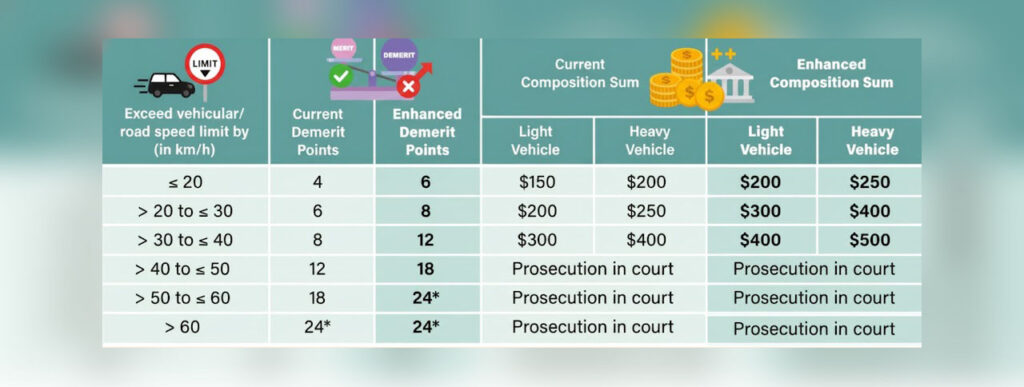
    1. Speeding Penalties Are Going Up — Like, Really Up

    If you thought LTA was playing around, think again. Speeding has gotten so bad that 2024 hit a five-year high in fatal crashes. Over 192,000 speeding violations. That’s more than 500 people every day deciding they’re auditioning for Fast & Furious: Bedok Drift.

    From 1 January 2026, penalties will become significantly harsher.

    • More demerit points (up by 2–6 points)
    • Higher fines
    • And if you exceed the speed limit by over 50 km/h, you’re looking at an automatic suspension.

    So if you like to zoom around in your BMW acting like Clementi roads belong to your grandfather, ah… better chill.

    For the rest of us, safer roads? Yes please.


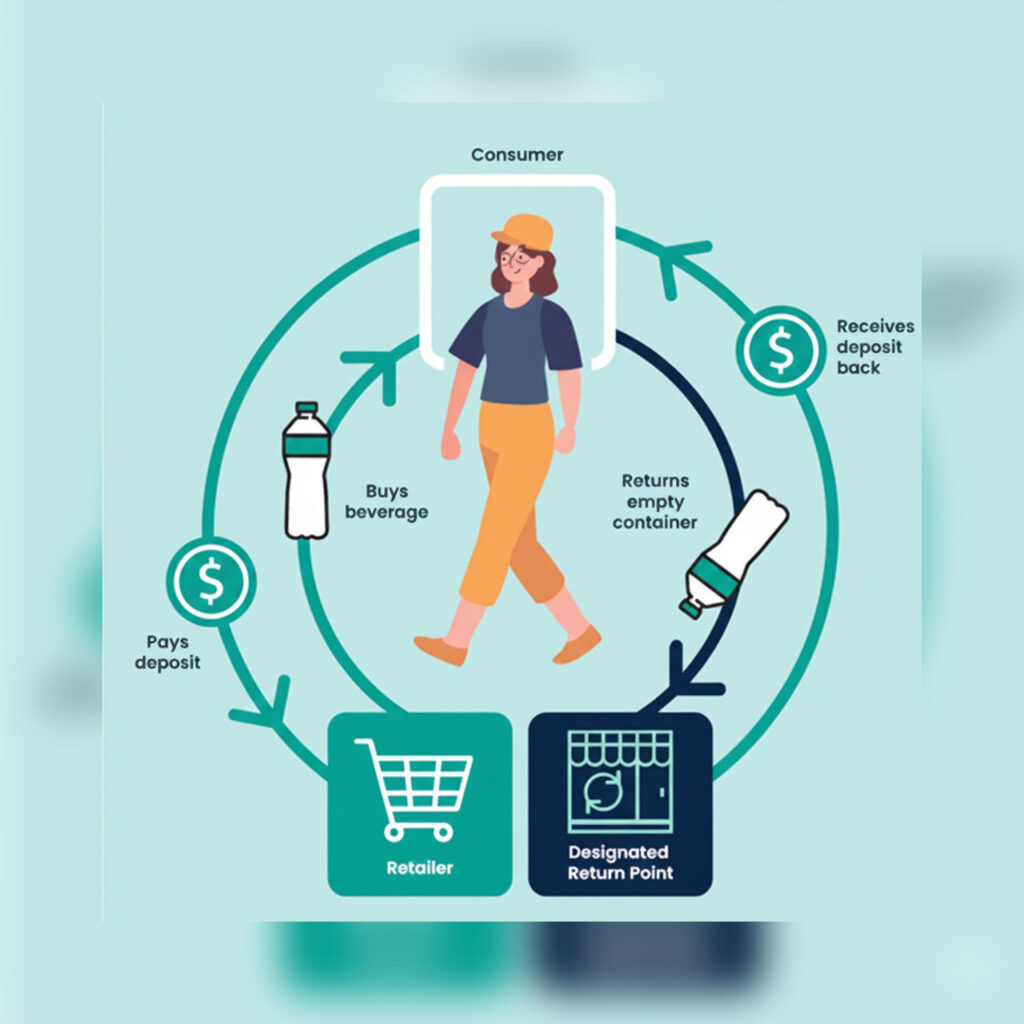
    2. Return Your Bottles or “Donate” $0.10 to the Void

    This one ah… many people confirm forget until they kena.

    Starting 1 April 2026, every bottled or canned drink you buy will come with a $0.10 deposit. Return the empty bottle or can, get back your ten cents. Don’t return? Congratulations — you just donated to environmental karma.

    There’ll be:

    • Over 1,000 return vending machines
    • Return stations at supermarkets
    • A new deposit mark on drink packaging from July 2026 onward

    Honestly, it’s not a bad thing. Good for the planet. Good for recycling. Good for your table, because maybe now your family won’t leave empty drink cans everywhere like modern art.


    3. The MRT to JB Is Finally Coming (No, Really)

    I know, I know — we’ve been hearing about this since dinosaurs were roaming Causeway Point. But guess what? The Woodlands–Johor Bahru RTS Link is actually on track to open in December 2026.

    Malaysia’s Transport Minister even said they’re testing trains. Wah, shocker.

    So you might actually be able to buy Christmas gifts in JB using Singapore dollars that magically stretch like rubber bands… assuming the exchange rate doesn’t suddenly go wild.

    Although hor, don’t put 100% hope. Early 2027 also possible lah.


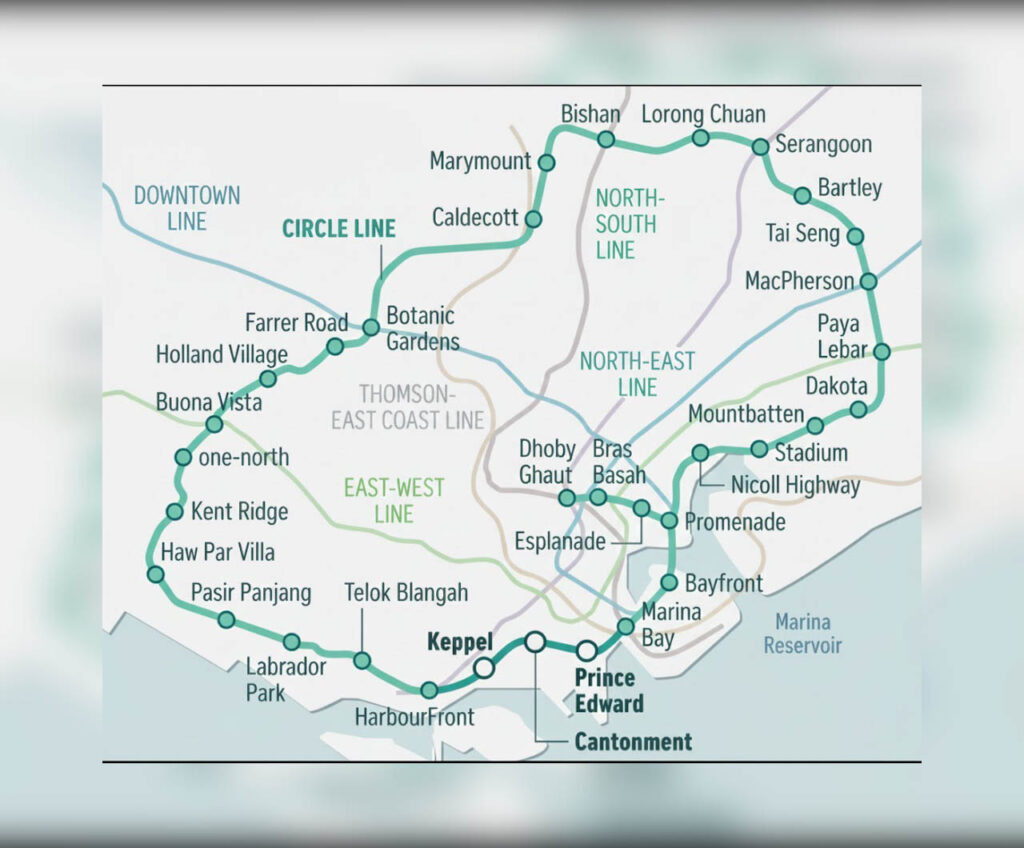
    4. New MRT Stations Everywhere — Finally Completing the Circle

    Good news for commuters who use “traffic jam” as their daily excuse.

    In the first half of 2026, three long-awaited Circle Line stations will open:

    • Keppel
    • Cantonment
    • Prince Edward Road

    This completes the Circle Line. Yes — a circle that is actually… circular.

    Then, second half of 2026, two new Thomson–East Coast Line stations and two new Downtown Line stations will open, linking through Sungei Bedok.

    More connections. More convenience. Yet somehow I still can’t connect to another human being romantically. Life is tough lah.


    5. Secondary School Students Also Cannot Use Phones in School

    Primary school kids kena the phone ban in 2025. Secondary kids join the club in 2026.

    No more TikTok during recess. No more IG stories from the toilet. No more pretending to do “homework” while actually scrolling for memes.

    Some teens say it’s the end of the world. But considering many students use smartphones almost four hours daily, maybe it’s time they practice… what’s that word? Oh ya — talking.


    6. Higher Minimum Salaries for Work Pass and S-Pass Renewals

    Hiring foreigners is going to cost more from 2026.

    Employment Pass (EP) renewals:

    • $5,600 (all sectors)
    • $6,200 (financial sector)

    S-Pass renewals from 1 September 2026:

    • $3,300 (all sectors)
    • $3,800 (financial sector)

    New applications already follow the higher salary guidelines. For renewals, 2026 is the switch.

    Ideally, this means more opportunities for Singaporeans and PRs. But also, ah… let’s be honest — some bosses might still say “must see experience lah.”


    7. CPF Contribution Ceiling Rising to $8,000

    Don’t panic. This one only affects people earning more than the current CPF ceiling.

    Before 2023, CPF contribution capped at $6,000 salary. Since then, the ceiling has been rising steadily.

    The progression:

    • Sep 2023: $6,300
    • Jan 2024: $6,800
    • Jan 2025: $7,400
    • Jan 2026: $8,000

    So from 2026, if you earn above $8,000, more of your salary goes to CPF. If you don’t earn above $8,000… just drink water and carry on lah.


    8. Shared Parental Leave Increasing to 10 Weeks

    Great news for new parents.

    Starting 1 April 2026, Shared Parental Leave jumps from 6 weeks to 10 weeks for babies born on or after that date.

    So unborn babies ah… if you want your parents to rest more, maybe schedule your arrival accordingly. Hah.


    9. Retirement and Re-Employment Ages Going Up

    From 1 July 2026:

    • Official retirement age: 64 (currently 63)
    • Re-employment age: 69 (currently 68)

    This is part of the larger plan to raise retirement to 65 by 2030. Basically, Singaporeans will keep working longer — because we live long, we age slower, and let’s be honest… teh peng prices keep going up.


    10. Online Safety Commission Will Protect You From Digital Nonsense

    Imagine your ex hates you and decides to sabotage you online. In 2026, they’ll have a harder time.

    An Online Safety Commission will be formed in the first half of the year. They can:

    • Help remove harmful or illegal online content
    • Identify the person who posted it
    • Step in when platforms refuse to act

    Safer internet? Finally. Less cyber bullying? Hopefully. Less people posting nonsense? A man can dream.


    My Honest Take

    Honestly, 2026 feels like that year where Singapore decided, “Okay lah, let’s just upgrade everything at one go.”

    Some changes scare people. Some make us roll eyes. But many are genuinely for long-term good.

    Stricter speeding rules? Great — I like being alive.
    Deposit refunds for recycling? Good for the environment.
    More MRT lines? Fantastic — maybe my bus will finally stop ghosting me.
    Phone ban in schools? Needed — kids need to relearn eye contact.
    Online safety laws? About time lah.

    Singapore is leveling up. Slowly, steadily, but surely — like your friend who keeps saying “I will start gym next week” and finally does.

    Top 10 Highest-Earning OnlyFans Creators in 2025: Who’s Really Making Bank?

    0

    OnlyFans has become the place where creators turn attention into actual money — big money. Like, “CEOs sweating bullets” kind of money. Although it began as a hotspot for adult content, it’s now the playground of chefs, musicians, comedians, influencers, and basically anyone who knows how to sell a personal brand with confidence.

    Before we dive into the Top 10 list, here’s the quick tea.

    What Exactly Is OnlyFans?
    It’s a subscription platform where fans pay to see exclusive content. Think of it as VIP backstage access… except the backstage sometimes gets a bit spicy.
    Creators set their price, drop paid posts, collect tips, and OnlyFans takes 20%. Not bad considering some creators pull in millions every month.

    Why Everyone Is Obsessed With It:

    • You don’t fight algorithms — fans come straight to you.
    • The content rules are flexible.
    • And let’s be real, the gig economy has everyone hustling harder than bubble tea shops on Friday night.

    Now, let’s meet the creators who turned this hustle into a gold mine.


    Top 10 OnlyFans Earners in 2025


    1. Blac Chyna – $20 Million/Month

    Source: https://www.instagram.com/blacchyna/

    Once known for reality TV drama and celebrity feuds, Blac Chyna flipped her fame into a money-printing subscription empire.

    She gives fans a mix of luxe lifestyle access, PPV collabs with big names, and VIP tiers that cost more than your monthly groceries. People love the behind-the-scenes chaos, the glam, and the “no filter, no shame” energy.

    Her business model is simple:
    You want the tea? Pay up.


    2. Bella Thorne – $11 Million/Month

    Source: https://www.instagram.com/bellathorne/

    Bella went from Disney sweetheart to artistic-erotica queen. Instead of going full explicit, she leans into moody photoshoots, poetic captions, and a teasing style that drives fans wild.

    She blends her books, music, and acting career with her OnlyFans. It’s all very curated, very Gen Z rebel energy, and extremely profitable.


    3. Cardi B – $9.5 Million/Month

    Source: https://www.instagram.com/iamcardib/

    Cardi uses OnlyFans like her private megaphone.
    Subscribers get:

    • Music previews
    • Unfiltered rants
    • Tour footage
    • BTS glam sessions

    She rarely posts anything too sexy — but honestly, her personality is the real main character. People subscribe because they don’t want to miss whatever she says next. Very FOMO-driven.


    4. Iggy Azalea – $9.2 Million/Month

    Source: https://www.instagram.com/thenewclassic/

    Iggy gives polished, magazine-level content that appeals to fans who miss her “Fancy” era. Her strategy? Sexy, glossy, almost-nude content that leaves just enough mystery.

    She mixes music teasers and lifestyle vlogs, targeting fans who like high production value and a bit of nostalgia.


    5. Coco Austin – $9 Million/Month

    Source: https://www.instagram.com/coco/?hl=en

    Coco is the true “bombshell mom” of OnlyFans.
    Her audience ranges from longtime Playboy fans to newcomers who found her on Celebrity Big Brother UK.

    Her niche?
    Throwbacks, glam-mom content, and cameos from Ice-T.
    Plus, she sells nostalgia packages — yes, really — for fans who prefer the 90s version of Coco.


    6. Mia Khalifa – $6.5 Million/Month

    Source: https://www.instagram.com/miakhalifa/

    Mia doesn’t post explicit content, and yet she’s still a top earner. That alone says a lot.

    She offers commentary, gaming streams, political chats, and satirical takes on her past — all wrapped in her signature humor. People come for curiosity but stay because she’s entertaining and unfiltered.

    She’s proof that being interesting is sometimes more profitable than being naked.


    7. Erica Mena – $4.5 Million/Month

    Source: https://www.instagram.com/ericamena/

    Erica pivoted from Love & Hip Hop drama to OnlyFans success.
    She basically turned her “controversial queen” reputation into a content theme.

    Her fans get fiery monologues, lingerie shoots, leaked messages, and dramatic tell-alls. She knows exactly how to stir the pot, then charge for the spoon.


    8. Bhad Bhabie – $4.4 Million/Month

    Source: https://www.instagram.com/bhadbhabie/

    From “Cash Me Outside” to multimillionaire — honestly, what a plot twist.

    Bhad’s content leans into her bratty persona. She releases PPV content for $100+, shares exclusive studio moments, and gives fans a behind-the-scenes look at her chaotic life.

    Whether people love her or hate her, they still pay. That’s influence.


    9. Tana Mongeau – $3 Million/Month

    Source: https://www.instagram.com/tanamongeau/

    Tana treats OnlyFans like a messy reality show with no censor button.
    Subscribers get:

    • Unfiltered chaotic vlogs
    • Drama updates
    • Surgery diaries
    • Influencer tea behind a paywall

    Her brand is literally “trainwreck you can’t look away from.” And it works.


    10. Gemma McCourt – $2.3 Million/Month

    Source: https://www.instagram.com/justgemmal/

    Gemma is the UK’s top female earner — and she built it from scratch.

    She dominates the fetish and roleplay market with custom videos, cosplay, and on-demand scenarios. Fans can even pay for real-time chats. She’s niche-focused, responsive, and strategic, which keeps her subscribers loyal.


    My Take

    Honestly, looking at this list, it’s pretty clear that OnlyFans isn’t just about adult content. It’s about branding, marketing, and knowing exactly what your fans want — sometimes better than they know themselves.

    Some creators rely on shock value.
    Others offer music, lifestyle, comedy, or nostalgia.
    Some barely show anything risqué and still earn millions just by being interesting or mysterious.

    One thing’s for sure:
    In this new creator economy, personality is the real currency.
    If you can sell a story, a vibe, or an identity — confirm plus chop, someone will pay for it.

    And whether we like it or not, OnlyFans has become one of the most powerful platforms for creators who want full control of their income and image.

    Who is Ivory Chia? The 9-Year-Old Singaporean Rising Star

    0

    If anyone still doubts that Singapore has serious talent brewing, Ivory Chia just walked in and said, “Hold my Milo.” This nine-year-old powerhouse snagged the Best Supporting Actress (Asia-Pacific) award at the Asian Academy Creative Awards (AACA), and honestly, the way she did it? Chef’s kiss. She went head-to-head with seasoned queens like Oscar winner Youn Yuh-jung, Taiwan’s Fang Wenlin, TVB darling Yoyo Chen, and China’s He Ruixian. Then she casually walked away with the trophy like it was just another school medal from Sports Day.

    And mind you, this is only two months after she already won the Singapore category. Basically, our girl stepped into Asia-Pacific like, “Okay lah, next level.”


    The Big Moment: From Shocked to Slay Mode

    At the ceremony, Ivory showed up in a vibrant blue-and-pink floral sarong kebaya — very on-theme, very Peranakan chic. When her name was announced, she literally jumped up with her hands over her mouth. Then she marched onto the stage with the confidence of someone who definitely didn’t expect it but also low-key deserved it.

    She thanked everyone from AACA to Mediacorp to the producers, directors, writers, and even the crew. At one point she was panting from excitement, and 987 DJ Joakim Gomez knelt to hold the mic for her like the human equivalent of a pop-up mic stand. Truly a core memory unlocked.

    She also gave a sweet shoutout to her “nya nyas,” Chen Liping and Jesseca Liu, for giving her warmth and confidence. That’s found-family energy right there.


    The Role That Won Asia’s Heart

    Source: ivorychiazhixuan

    Ivory plays young Xin Niang in Emerald Hill, the spin-off of The Little Nyonya. She’s a street-smart, sharp-tongued child beggar raised by Ah Zhu, Chen Liping’s gambling-addict character. Despite being the youngest on set, Ivory somehow manages to hold her own against actors who’ve been in the industry longer than she’s been alive.

    Source: ivorychiazhixuan

    Her performance? Bold. Sassy. Ridiculously good. She’s basically the kind of kid character who steals the whole show and leaves adults panic-Googling, “Who is this child actress???”


    But Wait, She’s Been Acting Since She Was SIX?!

    Ivory’s no overnight success. She first hit our screens at age six in Love at First Bite, where she played the younger version of Chantalle Ng. That was just the warm-up. Since then, she’s appeared in:

    Ivory Chia and Shane Pow
    • Soul Detective
    • Family Ties
    • Shero
    • All That Glitters
    • Moments
    • Once Upon a New year’s Eve
    • Hope Afloat
    • I Believe I Can Fly

    And she’s still in primary school. When I was nine, I couldn’t even finish my tingxie without crying.


    Her Acting School? Oh, It’s Pretty Legit.

    Zoom Academy website

    Ivory trains at Zoom! Academy, where adults AND kids learn acting and hosting. Fellow Emerald Hill actor Charlotte Yue studies there too. And one of the trainers is Priscelia Chan — yes, the Priscelia Chan — who also appears in Emerald Hill. So Ivory’s not just talented; she’s surrounded by industry heavyweights.


    And She Still Scores School Awards?!

    Ivory Chia holding the CCC-CDC Education Merit Award 2024 Source: ivorychiazhixuan

    Recently, Ivory received the CCC-CDC Education Merit Award 2024, which recognises academic excellence and good character. Celebrities like Ya Hui, Jesseca Liu, and Chen Liping all hopped into her Instagram comments to cheer her on. She’s basically doing better at life at nine than many of us did at twenty-nine.


    Star Awards Nominations? Of Course.

    Ivory’s talent hasn’t gone unnoticed. She’s been nominated twice for the Young Talent Award at the Star Awards — once in 2023 and again in 2024. No wins yet, but with the momentum she’s building, it feels like only a matter of time before her shelf starts getting crowded.


    She Even Has Her Own Fan Club (Not Joking)

    Ivory already has a loyal fan base, including Love 972 DJ Chen Biyu. She even has an official fan club launched last November. This girl is nine, and she has more organised fans than half the influencers on TikTok.

    Honestly, Ivory is the kind of talent Singapore has been waiting for. She’s sharp, expressive, hardworking, and she has that quiet charm that makes directors go, “Oh yes, that’s the one.” Also, her ability to stay grounded while juggling school and acting? That’s not easy. Many child actors get burnt out or overwhelmed, but she seems to be handling it with grace — plus a little shy-girl energy, which makes her even more endearing.

    I think she’s on track to be one of Singapore’s breakout stars in the region. Give her a few years, and she might just be the one other countries brag about “discovering.” Sorry ah — we got her first.