



Two teenage girls went missing. Parents panicked. Social media exploded.
And honestly? The internet did what the internet always does — amplify everything, feelings included.
Here’s what we know first.
Amber Lim En, 13, and Katelyn Lim Wen Xin, 14, ran away from home on December 30. Four days passed. No contact. No updates. Their parents, understandably shaken, turned to social media. Videos were posted. Tears were shed. Pleas were made.
From a parent’s point of view? Totally get it.
When your kid disappears, logic flies out the window. You grab at anything that might work. Facebook, Instagram, WhatsApp groups, aunties, uncles — just blast and pray.
But here’s the thing.
The internet doesn’t come with an “undo” button.
When Panic Goes Public
Let’s be real. Posting your child’s face everywhere feels like action. It feels like you’re doing something instead of sitting at home staring at the wall.
Actually, that instinct is very human.
But the moment those photos go viral, a quiet family crisis becomes a public spectacle. Everyone has an opinion. Everyone becomes CSI Singapore. Comments start flying — some helpful, some unhinged, some straight-up cruel.
And for teenagers? That hits different.
Try Seeing It From Their Side, Can or Not
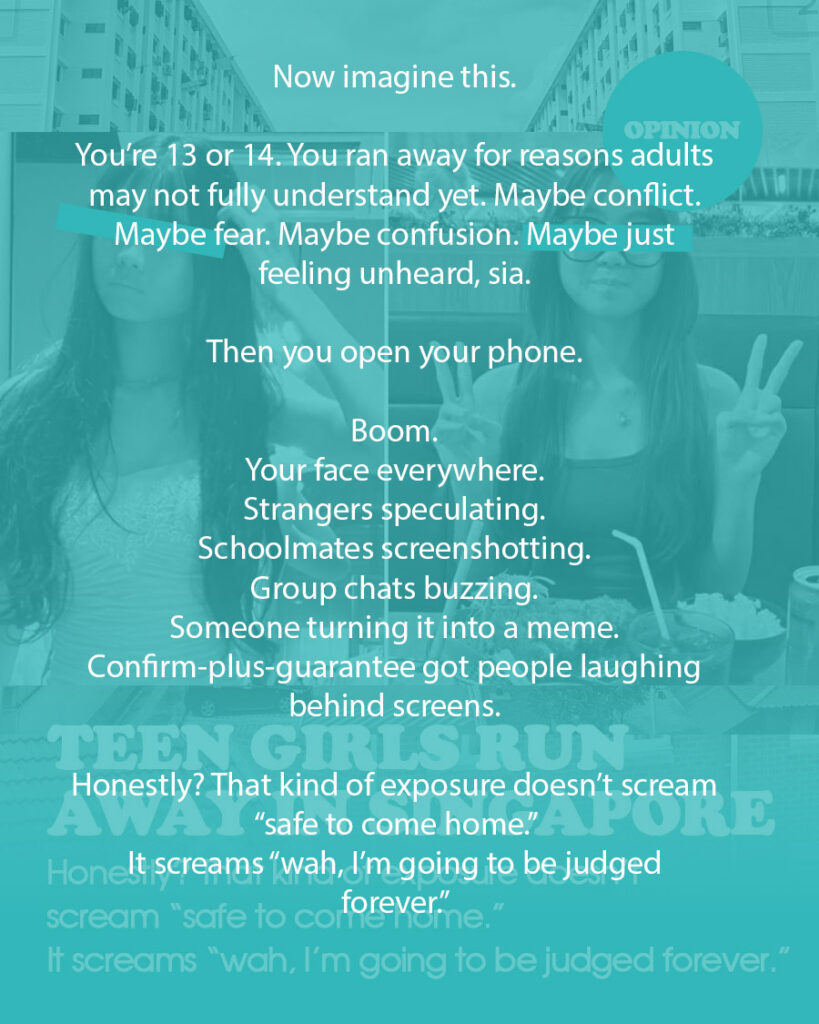
Now imagine this.
You’re 13 or 14. You ran away for reasons adults may not fully understand yet. Maybe conflict. Maybe fear. Maybe confusion. Maybe just feeling unheard, sia.
Then you open your phone.
Boom.
Your face everywhere.
Strangers speculating.
Schoolmates screenshotting.
Group chats buzzing.
Someone turning it into a meme. Confirm-plus-guarantee got people laughing behind screens.
Honestly? That kind of exposure doesn’t scream “safe to come home.”
It screams “wah, I’m going to be judged forever.”
When school reopens, it’s not just whispers. It’s stares. It’s questions. It’s labels. Once that happens, shame kicks in hard. And shame doesn’t push people home — it pushes them further away.
| The Parent’s Intent (Urgency) | The Teen’s Reality (Dignity) |
| Visibility: I need everyone to look for my child right now. | Exposure: I am now “that girl” who ran away. Everyone knows my business. |
| Connection: I want them to see how much I love and miss them. | Surveillance: I feel hunted and watched by strangers, not found by family. |
| Support: The community is rallying behind us to help. | Judgement: The comments section is dissecting my family life and my mental health. |
The Internet Never Forgets, Leh
Adults forget this sometimes.
Online posts feel temporary. But they’re not.
Screenshots live forever.
Downloads live forever.
Group chats live forever.
Even if the girls return safely — which everyone hopes — the digital trail stays. That’s the part that scares teens the most. Not punishment. Not scolding. Public humiliation.
And honestly, that fear is not irrational.
So What Actually Helps?
This part is uncomfortable, but important.
Public pleas may help locate someone fast.
But they can also backfire emotionally.
A quieter approach sometimes works better — police involvement, trusted adults, school counsellors, relatives, friends who can reach them without broadcasting their faces to the whole island.
It’s not about blaming parents. Not at all.
It’s about recognising that fear-driven decisions can have long shadows.
If I were one of those girls and I saw my face plastered all over social media, I’d feel exposed, embarrassed, and honestly… angry.
Not because my parents don’t care.
But because my worst moment became public entertainment.
Coming home would feel harder, not easier.
Facing friends would feel impossible.
The shame would scream louder than any “please come back.”
Care isn’t just about urgency.
It’s also about dignity.
If we truly want young people to come home safely, we need to ask a tough question:
Are we helping them feel safe — or just helping ourselves feel less helpless?
Sometimes the loudest move isn’t the wisest one, lah.