

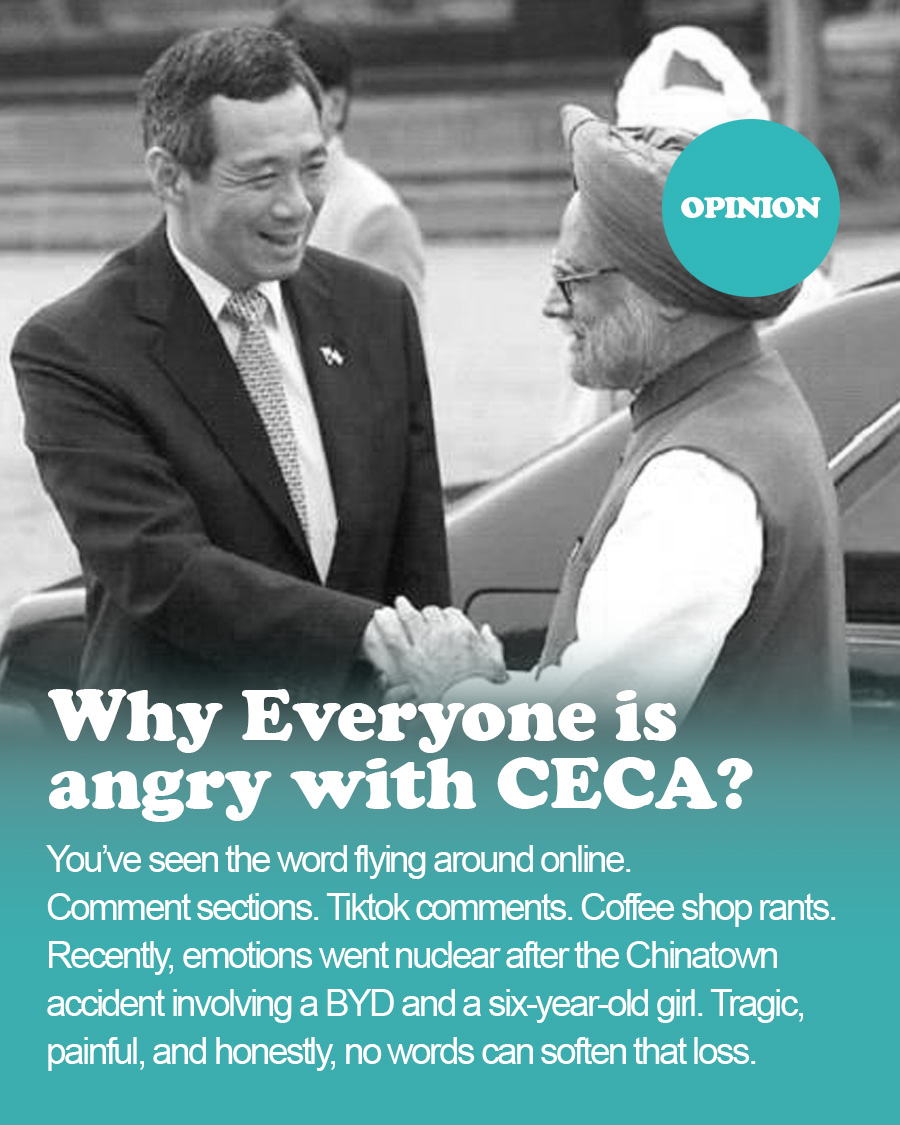

CECA.
You’ve seen the word flying around online.
Comment sections. WhatsApp chats. Coffee shop rants.
Recently, emotions went nuclear after the Chinatown accident involving a BYD and a six-year-old girl. Tragic, painful, and honestly, no words can soften that loss.
But here’s the thing.
CECA keeps getting dragged into conversations where it doesn’t even belong. So let’s slow down, breathe, and actually unpack what this thing is — minus the shouting.
First things first: What exactly is CECA?

CECA stands for India–Singapore Comprehensive Economic Cooperation Agreement.
It’s not a secret backdoor.
It’s not a magic passport printer.
And no, it’s not a free-for-all.
It’s a trade agreement. Signed in 2005. Super ong time ago already…
The whole idea was simple on paper:
Make it easier for Singapore and India to trade goods, services, investments, and yes, people — in specific, controlled ways.
That’s it.
So why do people use “CECA” like an insult?
Honestly? Because it became shorthand online.
Over time, some folks started using “CECA” to loosely refer to Indian nationals working in Singapore. Especially professionals. Especially when job competition comes up.
Is that accurate?
Not really.
Is it emotionally charged?
Confirm-plus-guarantee.
But emotionally charged doesn’t mean factually correct.
A quick rewind: How CECA came to be
Back in the early 2000s, Singapore was doing what Singapore always does — thinking long-term.
A study group looked at trade, services, investments, and global competitiveness. The report became the base for negotiations with India.

Singapore sent a 30-member negotiation team, led by Heng Swee Keat (yes, Ah Heng).
There were 13 rounds of negotiations. Not anyhow sign one.

CECA was officially signed on 29 June 2005, during PM Lee Hsien Loong’s visit to India.
The official goal?
Boost trade.
Encourage investment.
Share ideas and talent.
Very economist, very spreadsheet energy.
Okay but what does CECA actually do?
Let’s break it down without headache.
1. Tariffs: Gone or reduced
Tariffs are basically taxes on imports.
Higher tariff = higher price for you.
Under CECA:
- About 75% of Singapore exports to India had tariffs removed or reduced over time.
- Indian goods entering Singapore? Zero tariffs from day one.
So yes, cheaper imports.
And yes, better access for Singapore businesses into India.
This benefits industries like:
- Electronics
- Pharmaceuticals
- Plastics
- Precision instruments
Not sexy, but very important.
How does this affect regular Singaporeans?
Actually, more than you think.
Lower tariffs mean:
- Cheaper goods
- Lower business costs
- More competitive local companies
And when local companies do better, they hire more, invest more, and survive longer.
But here’s the part people skip…
Jobs, professionals, and the uncomfortable truth
CECA does not automatically grant anyone the right to work in Singapore.
Work passes are still governed by:
- MOM rules
- Quotas
- Salary thresholds
- Skills requirements
If a foreign professional is here, it’s because:
- The company applied
- MOM approved
- They met the criteria
Is the system perfect?
No lah.
Are there enforcement gaps?
Sometimes, yes.
But blaming CECA for every job anxiety is like blaming the MRT map for a train breakdown. Wrong target.
About the Chinatown accident

This part needs to be said carefully.
A child died.
That’s the real tragedy. Period.
Turning that pain into racial or policy rage doesn’t bring justice. It only adds noise.
Traffic laws, driver responsibility, enforcement, and vehicle safety — these are the real issues that matter here. Mixing it with CECA just muddies everything.
Two separate conversations. Please don’t lump.
Still sounds abstract? That’s fair.
Trade agreements are boring.
They don’t come with TikTok explanations.
And politicians don’t exactly break it down kopi-style.
So frustration fills the gap. Rumours rush in. Anger gets an easy target.
Very human. But still dangerous if left unchecked.
Between You & Me
Between you and me, a lot of the CECA anger isn’t really about CECA.
It’s about:
- Feeling stuck
- Feeling replaceable
- Feeling like the system always favours “someone else”
That feeling is real. I won’t dismiss it.
But aiming that anger at an agreement signed 20 years ago won’t fix today’s problems. Better enforcement, clearer data, fair hiring practices, and honest conversations will.
Singapore has always survived by being open and disciplined. Not one or the other. If we lose either, we’re in trouble.
You don’t need to love CECA.
You don’t need to defend it blindly.
But if we’re going to be angry, at least be angry at the right things.
Otherwise, we’re just shouting into the void — and the void doesn’t fix policy.